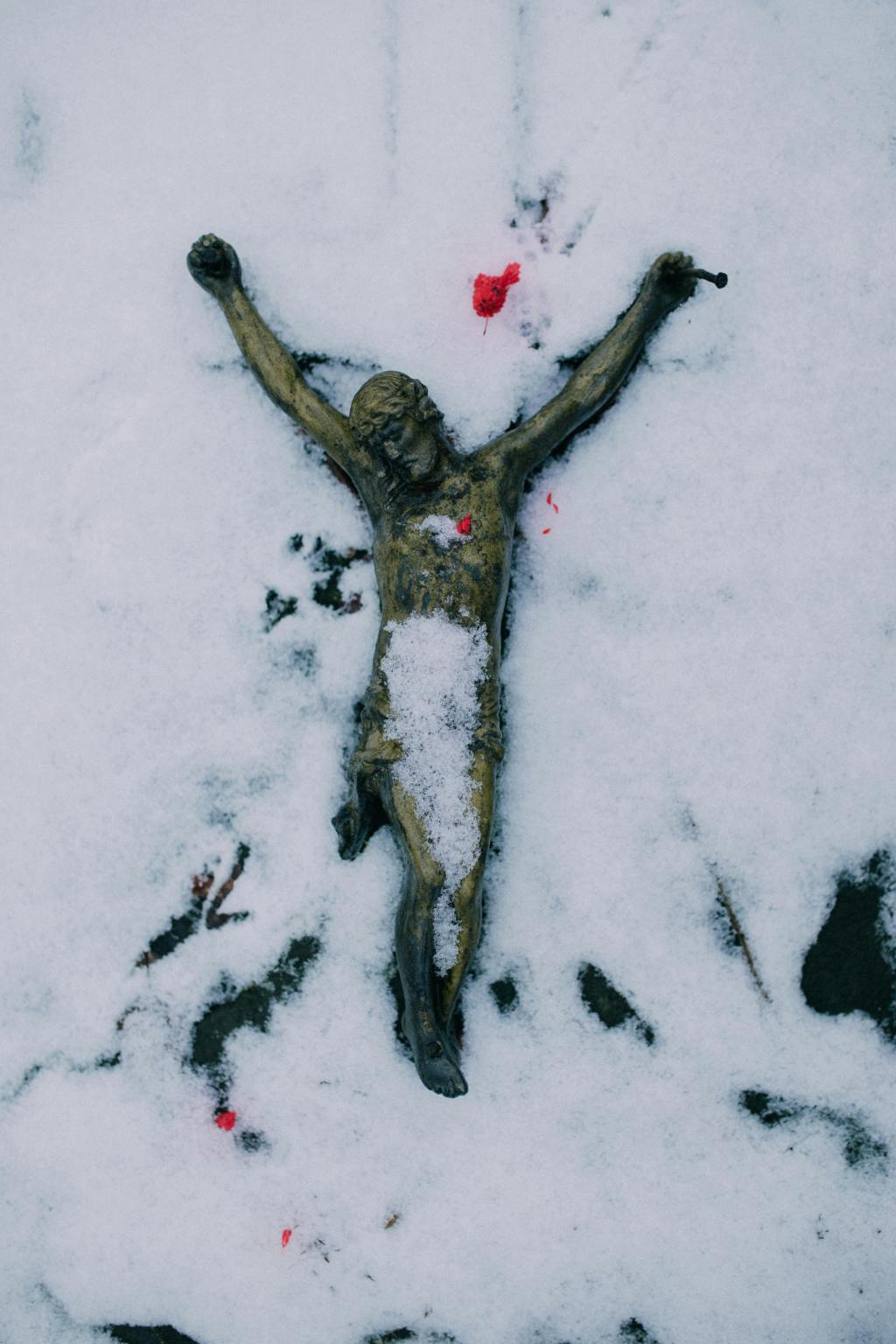
Five graves on the hillside.
That was all that was left of them. A wife, two sons, two daughters. Hopes and dreams covered in soil and stone, the promise of lives barely started snuffed out by malice and fear.
Five graves on the hillside.
They hadn’t even allowed Oscar to bury them on the top of the hill, where they could watch over the town for eternity, or on the east side where they could have the sun on their faces. No, they lay near the base in the damp southwest, not even looking directly at sunset.
Five graves on the hillside.
Oscar had dug them himself through tears and hate beneath the eyes of his tormentors. The village depended on hot springs to keep life going in the dead of winter, and to maintain the sweat lodges on the hill brought to them by Irish slaves two generations before that helped them through illness and cold alike.
The springs were his only helper now; the heat had kept the soil pliable enough to work with even as the rest of the hillside was caked with ice and snow. The seven elders, clad in red robes trimmed with green and inlaid with tiny silver bells that jingled as they walked, had surrounded him as he laboured to break through the cold, hard ground. It was a bright day beneath the blazing star that had erupted three nights before and was as bright in day as darkness. It was a glorious day, and yet Matthew felt nothing glorious about this. The elders had called it justice. Matthew, who had been Ongar in his childhood before his bath at the hands of the Jesus-man, saw nothing just about what they had done. What he had failed to prevent happening.
The Cross had come slowly, fjord by fjord and valley by valley. The first Christians had been brought as slaves from Ireland, strange, adze-headed creatures of ferocious will and ability to speak florid poetry. They spoke of a God of the desert, a triple God who could love as deeply as Freya and scourge as powerfully as Odin. They could not be broken, the grandfathers told Matthew’s generation as children. They could not be broken.
They had died out, in time. Accepted death as if it were a thing of nothing, braver in the face of the axe and raiders than many a thrall. So did they lay the seeds of the present day, of a slow and peaceful conversion where the old temples were washed clean and adorned with stone crosses, where the old gods were driven from their safe places in the hearts of the people and exiled to the rough ground, broken soil, blackest caves.
Five graves on the hillside.
That was all that remained of those who held wholly to the old ways. Matthew dropped his head to his chest and let a tear fall as he mouthed a prayer for their souls.
He wasn’t praying for them, though. Not really. He was praying for himself and all those on the council in Altfjord who had heard the word of the itinerant preacher Klaus.
He had burnt out his own eyes so as not to be polluted by visions of the temporal world. His nine deer-clad acolytes followed him as he travelled across the snow-blasted country in a rough hewn sled, bringing hemp sacks of food and far-off luxuries like pepper to villages that would seldom see such things. With their attention caught by gifts, his chief disciple, the bruising hulk
Rudolf, whipped people into a frenzy as Klaus demanded the last pockets of the old ways be rooted out and burnt as an offering for his God from over the sea. A gift to mark the birth of God’s son, to show his mastery over Yule and the disir, the goddesses and spirits worshipped by their ancestors who were still said to dwell in damp wooded places.
Kings would not have allowed it. But the kings of Norway had no power here. Altfjord, so far north and west, was rough land remote from any seat of power. Only God wanted it.
And so the seven elders and a gaggle of followers had dragged Oscar’s family out of their turf home on the lakeside, and strung them up by the ankles, and whipped them, and crucified them when they prayed to Thor instead of Jesus. Even Matthew, a kind man who had seen Oscar’s wife Dagmar heal the poor and rich alike with herbs and potions, had been swept up by the bloodlust, buoyed by the absolute self assurance of the group.
“Please, Ongar,” she had said to him, knocked to her knees and left eye swelling with blood. “Please. We have done nothing wrong.”
He had loved her since they were children. He still did, even after she had chosen Oscar, that preternaturally strong whippet of a man who like the shamans of old would disappear into the forest to worship the ancient gods with hunting and prayer. “I’m sorry,” Matthew whispered, kissing her on the cheek before nodding to two others to take her away. “It’s for your own good. You’ll be rewarded in the next life.”
It was a righteous cause, they said. They were doing God’s work, they said.
They kept saying that, as if by saying it over and over they could convince themselves that they were in the right.
It was only when they killed the baby that they had started to falter, despite the fire in Klaus’s voice as he praised them for freeing a child of a lifetime of corruption.
They could have thrown the corpses in the clay pits two miles hence, with the lepers and the unclean. But to do such a thing to an infant seemed like an abomination to even Bodmar, the most zealous of them, the one who had first invited the corpulent white-beared Klaus to their wilderness. They paused, the mob dispersing and milling around unsure what to do next.
A man’s cry tore the silence apart. Matthew had never heard a man scream like that. It sounded like his soul was dying.
Fourteen men it took to bring Oscar down. His axe cut through the first three like a scythe through wheat. The fourth died choking on his own blood from a single punch to the face. Two more were maimed beyond recognition before a blow to the head slowed Oscar but he was still a flurry of punches and kicks. “Spare him, spare his miserable life,” bellowed Klaus. “God has a plan for this heathen creature.” They swamped him then and won only with the cost of blood and broken bones.
Bodmar led the restrained man away. Oscar, so serious and grown up even while a child alongside Matthew and Dagmar, sobbed with more pain than any many should have to bear. Hesitantly, Matthew reached out to comfort his friend – and in truth he loved Oscar still as a brother – but a white-haired elderman, Asger, slapped it away, glaring at the broad-shouldered younger man. “Stick to the task,” he said through gritted teeth.
Love one another, that was Christ’s commandment. Matthew’s learning had been haphazard, but that lesson had stuck with him. Yet they had shown no love here, and Matthew fell behind the boisterous, triumphant gang of jailers as his heart sank at the thought that Christ would cast him into hell for his part in this corrupt praise of his birth.
Five graves on the hillside.
They made Oscar dig them. Said it was a last penance. He spat at Bodmar’s feet. “I need nothing from your God,” he hissed as the snow began to float down gently. Down and down it drifted as he dug five shallow pits. Tenderly, he raised the soil and stones into five little barrows for five innocent souls.
With the last rays of sunlight, he fell to his knees and closed his eyes, enjoying one final moment of peace.
He didn’t resist as Asger, village chief in all but name, looped the rope around his neck, and he said nothing as they dragged him half a mile down the slippery broken path toward the village. Klaus’s acolytes had gone on ahead. It was not an impressive place. Set on a lakeside but within sight of the sea, it was a disjointed huddle of wood, stone, and turf huts clustered around a low-slung building that functioned as part guest house, part communal hall. They had decided years ago to do away with having a chief, trusting instead in a council of seven drawn from the people.
Life revolved around a crude semi-circle of packed gravel and cobbles in front of the hall. In the centre of this marketplace, where in happier days fish, meat, and the other trappings of daily life changed hands, stood a rude pyre made of a fallen oak trunk and piles of broken planks of wild cherry. They lashed him to it, jeering and leering in their stinking furs and shredded trousers as they leapt about barefoot even in the frigid cold.
“Come, come brothers and sisters,” bellowed Klaus from his sled. “Watch how God makes the heathen pure. Watch how God sets the sinner free.”
The villagers, creeping out of their huts to join those who had come in from the broad countryside, gathered in a huddled mass, a congregation before an altar of horror. They had seen executions before. Beheadings, enforced gorging on mistletoe, a bloody eagle. But always for crimes, true crimes. Murder, rape, sedition. Never had the crime been to be a father, a husband, a follower of traditions older than the desert God who had supplanted them. The devout basked in a demonstration of their militant faith. The rest, dispassionate believers for the most part, wondered if some day the mob would come for them.
Oscar didn’t flinch when the acolytes poured whale fat on the timber and threw the first torch onto it. He didn’t cry out as the flames licked his legs, red and green sparks rising around him and flying into the darkening sky. He just stared at them, the laughing disciples of pain as they rang their bells and sang in praise of their Lord. He stared at them until the flames grew high enough to blot him out. The acolytes cheered as one. The villagers remained silent, hands covering their mouths.
One by one they melted away as the skies rumbled, Thor welcoming his last follower to Valhalla perhaps. The snow was coming down in sheets now, great gobbets of ice that hissed and spat as it hit the dampening fires, beating them down until all that was left was a charred lumpen mess.
“Look at how merciful God is,” yelled Klaus, “look how the rust of sin is burnt away in honour of our saviour’s birth!” Then he gestured imperiously for his followers to bring him indoors. Even prophets liked their modest comforts from time to time.
That night, in the dark and smokey hall, they feasted. Even the lukewarm among them thawed and pretended, at least for a time, that Oscar’s immolation was just something from a dark story. So they turned to food and drink and song to chase the memory away. Slabs of fresh beef from cattle slaughtered that morning to avoid feeding them through winter; roasted turnips and onions flavoured with wild garlic; fish and nettle soup; great hunks of bread broken roughly in callused hands; bowls of berries long frozen in the snow; flagons of mead spiced until sweet and aromatic with juniper. There would be several nights of this revelry, and while it would stretch their winter stores it was a time of celebration that usually kept the village’s morale up as it faced through the hardest part of the season. The visitors laughed and sang but the merriment felt forced. Five of the village elders sat close to the fires, picking at their plates without tasting anything. The other two, Sigurd and Ivar, were on either side of Klaus, laughing uproariously like braying donkeys.
“We did what had to be done,” said Asger eventually. He had travelled widely in his youth, raiding and trading across Europe before settling in the quiet north. He could speak and read three languages. Had he lived in sunnier climes he would have been considered a philosopher. “All he had to do was put on a mask and go to church with the rest of us. But a real pagan can never be reasoned with.” He swigged from a wooden tankard, savouring the mead on his tongue.
“Did we try, though?” asked Matthew eventually, eyes burning from smoke and regret. “Did we really try?”
Asger scoffed and the others nodded their heads one after the other in mimicry. “You’re too soft, Matthew,” Bodmar said, laughing. “The meek will inherit the earth, true enough, but it’s not time to be meek just yet. Now is the time for hard men.”
“Men don’t kill women and children,” spat Matthew. “Not real men.”
Bodmar leaped to his feet, teeth bared and face wrinkled with rage. “You fucking coward!”
Matthew rose slowly, lips tight and grim. “Come on, then,” he said softly. “Show me what a real man is like.”
Bodmar scrabbled at his belt, looking for a dagger that was hanging on a peg in his home. Matthew leapt over the embers, fists clenched. Asger, Ragnar, and Aebbe the Saxon jumped to hold them apart. “Enough, Bodmar, enough,” they said through gritted teeth as they strained against Matthew’s great strength. Bodmar was big, but Matthew was bigger.
He could smell the honey on Bodmar’s breath, the garlic on his sweat. He could have taken him down with one punch, and in his youth wouldn’t have hesitated. But he was a father now and he had sworn oaths to be a good upstanding Christian, and that stayed his hand.
“I didn’t see you try to stop anyone, you fucking hypocrite,” said Bodmar, spitting in Matthew’s face.
The door crashed open, a chill wind whipping through the hall as a white-faced child of about seven bundled in red and blue collapsed in.
“I think that’s your lad,” Ragnar said, tapping Matthew on the arm. Barely able to tear his glare away from the simmering Bodmar, Matthew turned slowly to see his son Peter stagger toward him, barely able to hold his head up. He scooped the child up a second before he fell. His eyes were wide and he was shivering despite his heavy clothing. “Papa. Papa,” he whispered.
“What is it son?”
“There’s something outside.”
“What? Speak up, lad.”
The room had fallen silent and a concerned group was clustering around the two of them. Could it be a fever? A new plague? Why was the child so clammy and cold? The whispers ran around the room like lightning even as Matthew waved away their concerns. “Come on, Peter,” he said, leaning in close.
“It’s outside, papa. In the fire.”
Matthew and Ragnar exchanged a startled look as Matthew’s wife Alva rushed in to take the child. “Get him home,” said Matthew as he pulled his robe tighter and grabbed the nearest torch to go back into the cold.
It was pitch black apart from the flickering light of a few torches barely holding their own against the sting of the winter breeze. They crunched through the snow, following the boy’s footprints, which were already filling in with fresh snow. He had been running, judging by the length of the strides, and running hard.
They moved slowly, Matthew and Ragnar in the front and half a dozen hangers on some ten feet behind. Matthew’s breath chilled instantly on his moustache and he wished he’d retrieved a knife, or a club, or something that he could just hold as a weapon. His heart hammered and he had a sick feeling in the pit of his stomach, the sort of feeling where you know, you just know, that something very wrong has happened.
The tiny footprints merged suddenly into a frantic mess of a pit. “He fell here,” said Ragnar. “Did somebody push him?”
“There are no other footprints,” said Matthew, peering into the gloom before holding his hand up abruptly. “Wait,” he whispered. “What’s that?”
Slowly, ever so slowly, he raised the torch up to try and throw back the dark.
The remains of the pyre had already been partially covered by snow drifts. The smell of cherry wood and fire caught in the back of his nose and throat. Fire and… something else.
He lifted the torch a fraction higher. And something in the dark moved.
A chaotic screech tore his innard apart and he clapped hands to his head as it felt close to bursting from the pressure. A black thing rose from the pyre, an entity of pure night that rippled like smoke in the torchlight and glared at him with fire-gold eyes. A cold wash of terror came over him as he felt all his greatest fears laid bare before them. The thing swept at him, ragged and enraged, a creature from the depths of nightmares fiercer than anything the gods and heroes of old had ever fought. It blasted him to the ground and his robe ignited. Rolling in the snow to put out the flames he could do nothing as it caught Ragnar in the face with a wisp of smoke and the flesh bubbled and roiled and melted from his bones in streaks as if clawed by human fingers.
The entity screeched again, and the acolytes scattered shrieking. Matthew dived to catch Ragnar as his knees gave way from the pain and when he looked up the thing had gone, melted into a night sky as black as it was.
“What is happening, what is happening?” slurred Klaus, his wild white beard stained with berry juice and breadcrumbs.
“Attacked, the men were attacked,” said one of the villagers.
“Attacked? By who?”
“A black cloud.”
“Has your brain gone soft, child?”
“He speaks true,” said Matthew, his ears ringing and chest howling in pain from his burnt clothes. Gooseflesh was rising all over him; as the frenzy of what happened faded he realised he was shirtless. “A cloud full of hate and fire. It’s destroyed Ragnar,” and he pointed at the barely breathing fallen man. “It was like a son of Muspelheim.”
Klaus choked back a bitter laugh. “Pagan superstition. I thought better of you than to talk of devils of old.”
“And yet it reached out and touched me, touched Ragnar, and I felt it. I’ve never felt God. But that… that thing I did feel. It was pure hate.”
“Blasphemy. Where has it gone, then, this cloud? Blown away in the wind?”
“I don’t know, I don’t know,” Matthew said, teeth beginning to chatter and head spinning. “Don’t know, don’t know, don’t–”
And then night fell for him everywhere, and he remembered nothing until he woke three days later in his own bed, his hands and chest coated with a grey green paste of herbs. Alva forced him to sit slightly, enough that he didn’t choke when she touched the cup to his lips. It was all he could do to not grab it from her hands and pour it down his throat in one. But he was too weak, and the pain washed over him like a stormy wave on the deep sea, and he blacked out again for a few moments.
“Ragnar,” he said suddenly as his eyes popped open. “Ragnar.”
“Ragnar is alive,” said Alva in clipped tones. “They have taken him south to the monastery. But it is a long journey and he is very weak.” She laughed bitterly. “If there had been somebody closer who was skilled in healing and generous in their care, perhaps he would survive.”
“Dag–” And he fell silent at the bitter memory of what he had been a part of. “Peter,” he blurted. “Where is Peter?”
“Oh, you remember your son now? And the first word from you is that bastard Ragnar?” She blew air through pursed lips. “Your son is well. Or as well as can be expected.”
“He is unhurt?”
“Yes. Frightened. He cries in his sleep.”
“He was lucky it missed him.”
Alva arched an eyebrow and bit the inside of her lip. “It looked at him, he says. Stared right at him. And then it said his name.”
Matthew boosted himself up with his elbow. “His name?”
“Yes. It spoke with Oscar’s voice, he says.”
“What did it say?”
Alva pulled at her braid while staring into the wall. “It said: ‘Behold, I am coming, and my reward is with me, and I will give to each person according to what they have done’. Do you know what that means?”
Matthew swallowed hard. “Those words. I know them.” He gestured to a sideboard with his chin. “The book, bring me the book.”
Shaking her head wearily Alva retrieved the little rough-bound thing. It had been put together by one of Klaus’ more learned disciples who came through from time to time to teach some of the villagers to read. The book was full of psalms and parables and angry things. Battered from travel and use, there was one gathering of leaves that stood out. It was a book of prophecy, the Revelation of John. It told of judgement and damnation, punishment and reward. Matthew knew the stories but had only learned to read some of them. He flicked over the pages, his finger hovering over the tiny, cramped script as he hunted for the words he knew he had heard before.
“Here,” he said at last, tapping the page and sweating from the effort of searching for it. “Here it is.”
“You know these scratchings mean nothing to me,” said Alva, glancing at it and pushing it away. “Klaus and the others like him, they do not want women to learn their meanings.”
Matthew furrowed a brow at how right she was and at the effort of recalling the explanation of the words he had been given. “It, uh, it is a promise by Jesus. He will return to give everyone what they deserve. The good… and the bad.”
Alva threw her head back and laughed. “Gifts for good deeds. Well this is a very happy Cristesmæsse.” Her mother had been brought from England. “Christmas,” that’s what they called this time of year there, though Matthew had never taken to the word. Alva kept laughing as she got up to check on Peter, fretting in his corner, and Matthew sank back on his rush pillow in stunned silence. How could a pagan know the words of Jesus better than a Christian? Was he being cursed by having his own faith turned against him? The thoughts swirled and gnawed at him until he drifted off into a fretful, dreamless sleep long after Alva and Peter had drifted off near the hearth.
*****
A hammering on the door woke all three of them with a start. Alva unlatched it to find a sweating Aebbe breathing clouds of steam in the dawn light. They exchanged a few short words in the Saxon tongue, both of them among the few descendants of English captives who still spoke it. Aebbe looked toward Matthew, who was slowly lifting his legs out of bed. Alva sighed and nodded.
Crossing the room the hook a hand under Matthew’s arm, she helped until he could support himself against the doorframe. He was milk white but his hands felt more pliable today. “What’s happened?”
“You need to come. The rest of the elders have already gathered.”
Matthew gestured weakly for Alva to help him haul a heavy coat on. He was somehow still wearing his trousers from the other night. “But what’s happened?”
Aebbe shook his head. “You’ll see. You need to see.”
Matthew and Alva always kept some shovels or poles outside the door to clear snow or mud, and one became his walking stick now. Aebbe hovered, half-expecting Matthew to fall with the slightest obstacle but the wounded man gritted his teeth and pushed on. His house was set back into some trees on a plot of farm land not far from the water. It usually took only a few brisk paces to travel from his door to his favourite fishing spot, but it might as well have been on the other side of the world. Breathing hard and sweating uncontrollably despite an unforgivable thirst, he pulled himself forward one brutal step at a time until the lake came into view.
Five of the elders were at the shoreline, talking in hushed tones. About twenty feet from shore was a small outcrop. The children just called it the Rock, and it was their landmark for swimming races in summer. Matthew had courted Alva on swims out there in the days after it became obvious Dagmar’s heart was set on Oscar. He had enjoyed sitting out there, pretending the rest of the world couldn’t get to them.
Now, impaled on a stump of hard black rock that hadn’t been there when they’d murdered Oscar, was the corpse of a man.
His body arched and broken right through the spine and stomach, face coated with frozen blood, Bodmar hung there with flecks of frost on his robes and hair, head thrown back and eyes staring vacantly at the sky. Chunks of ice floated in the water, as if they had been melted and broken just a short time ago.
“Mother of Christ,” whispered Matthew as the others made way to let him through. “What is this?”
“Vengeance,” said Asger, hands clasped in front of him while he looked across to the far side of the lake. “We thought were doing the right thing, the just thing by cleansing the old ways. But I fear God is angry with us.”
“No,” said Matthew, the old stories of his youth running wild in his mind. “Perhaps God was never here.”
“Don’t say that near Klaus,” snapped Sigurd.
“Well you have his ear, brown-noser,” said Rollo, Bodmar’s brother, his voice hoarse and eyes red with tears. He was not one of the elders but often joined them in their work.
“Do you want to end up like Oscar and his family?” asked Sigurd.
Ivar shushed them all and held a hand up, gesturing with a thumb to the path behind him. Rustling through the leaves were Klaus and three of his acolytes, one of them leading the old man safely over fallen branches and half-hidden stones. Rudolf was at his ear, quietly describing everything. The old man was shaking his head in exasperation. “Who else knows about this,” he called out, his voice subdued.
“None that we know of,” said Asger. “I saw it myself first. The rest of the village has been indoors so far, but we won’t have much longer.”
“Where did that black rock come from?” asked Ivar. “It looks like it’s shot out of the ground itself.”
“Not the priority. We need a boat, Ivar, you and Aebbe hop to it and get that little one over there.” Asger waved a hand at a rickety little thing that was typically shared by some of the children and younger adolescents to fetch each other from the Rock.
“I don’t think it’ll hold much weight,” said Ivar.
“No time. Go, before anybody else is up or the water freezes over again.”
Ivar and Aebbe, both fine, robust men close to six feet in height, pushed the thing out and winced at the cold while they waded out. The lake got very deep close to the Rock and it was no time of year for a swim. Watching them labour into the boat and row gingerly out, Matthew wondered just what sort of curse they had brought upon themselves. His throat dried and his breath caught as a little voice in his mind told him not even God would protect them from this. I will give to each person according to what they have done.
The boat crashed up on a flat part of the Rock, the only place it could land and avoid drifting away. Ivar hobbled out and held it in place while Aebbe followed. The Rock was wide enough that perhaps half a dozen grown men could lie on it. They picked their way over the crags, watching for patches of ice.
The black stump was about chest height, with about a foot of ragged stone impaled through the corpse. Aebbe, always the more pious though far from ordained, made the sign of the cross over the body and mouthed a scrap of prayer. It sounded like an apology, Matthew thought.
The two men looked at one another for a moment, Ivar gesturing for Aebbe to push from beneath while he lifted from above. Aebbe shrugged and Ivar braced himself on a bit of rock slightly higher than the rest. “One, two, three,” he said and they tried to hoist the body off.
The stump collapsed into dust and Bodmar’s body crashed onto the Rock, the bones cracking loudly. Ivar slipped and fell into the water with a surprised yelp, missing Aebbe’s hand by inches. The dust formed a cloud that screeched and boiled with rage until it formed the shape of a gargantuan man floating above the water, two ragged dragon’s wings beating slowly behind him. The burning amber eyes marked them all one by one. As they fell on Matthew the sky darkened and rippled and he was propelled up and out into a world of shadow. His head, why did it hurt so much? Why was the world off kilter? As if looking through a glass darkly, he found himself hanging upside down on a gibbet of obsidian. Was that his house? It was on fire.
The screams, the screams…
Two fiery shapes, one larger than the other, staggered out of the blaze and collapsed in front of the gibbet. Their faces melted and distorted and remade themselves and melted again.
“Alva! Peter!”
They couldn’t hear him. But the vast goat-legged demon standing over him could, and looked at him through the cloud with a savage ragged-tooth grin and burning amber eyes. It threw its head back and laughed as it made the first cut.
Hot red blood gushed out as the ebony claw sliced across his stomach. Not enough to gut him, not yet. Just enough to make him hurt and keep him to watch his wife and son burn and burn again.
“Death is no release,” said the demon in Oscar’s voice, sparks from the blaze catching on his horns. “Death is living in a moment forever.” It delicately carved along Matthew’s jawline, etching a line all the way around his face as his victim screamed. “You cannot hide, Matthew. I can see your true face.”
And with a gentle flick of its wrist it peeled the skin right off Matthew’s skull.
With a gasp he woke up on the hard packed snow. The others were strewn around him, whimpering and crying out. Even blind Klaus let out a wail of the purest despair. Matthew pulled himself upright just soon enough to see the black cloud vanish into the treeline.
“Christ above,” shouted Aebbe, waving at them from the Rock and hauling Ivar out of the water with an arm well used to rescuing small children from themselves. Ivar’s teeth were chattering and he hugged his body tightly in a futile attempt to keep out some of the cold. Aebbe guided him into the boat, looked to the group on the shore, then to the broken body on the stones, and scratched his forehead for a second. Pointing for Ivar to lie flat, he scooped up Bodmar’s remains and laid them on top of the freezing man, causing him to cry out in horror.
“Relax,” said Aebbe. “He’s dead. He can’t hurt you.”
On the shore within seconds, Klaus’s acolytes helped to lift the corpse out while Ivar struggled his own way out of the boat. “Get him inside,” Asger said to Rollo, who was fretfully checking his crotch to make sure he was intact. “Use my cabin, I was awake all night so there should still be some fire burning. And you,” he said pointing to Sigurd, “get the body back to your place, it’s the closest.”
Matthew’s house was much closer, but they knew what he meant. Sigurd, the ascetic who would have been better suited to some remote monastery in Ireland, lived alone outside of the village in a house made mostly of sods that he’d erected himself. He had wandered in one day a score of years previous, friendless and exiled by parents who had forsaken him for being baptised and driven him from his home village some ten miles west. He had never married, so his house would be empty. All the other elders had somebody at home.
“It’s a miracle that nobody is out yet,” said Matthew.
“Thank heavens for small mercies,” said Klaus. The fight had gone out of him, and his shoulders sagged. He was like a different man from the one who had led a massacre of innocents less than a day before, and shuffled rather than strode as his disciples led him away. “I could no longer feel him,” he was saying to Rudolf, “I could on longer feel God.”
Asger beckoned to Matthew. “Are you well enough to walk?”
Leaning on his makeshift crutch, Matthew shrugged.
Asger twitched his jaw at the departing Klaus. “You’re looking at a man who has never been beaten but now isn’t sure he’s on the right side.”
“I don’t get your meaning.”
Asger smiled sadly. “What did you see when the creature looked at you?”
“My family on fire. A demon was flaying me. But none of us could die.”
“I expect it showed us all our greatest fears.”
“How is such a thing possible?”
“If you believe in God you believe in the devil, or devils of some kind. You have grown up in the faith. I imagine all you know of what came before are stories.”
“I was in my sixth summer when they baptised me.”
“We were a Christian country by then. But I remember when the old gods were almost everywhere.” He pulled a sleeve up to show a faded tattoo of Thor’s hammer. “When I was a child, my grandfather used to tell us that even the gods were new. That there was something beyond them, greater than them. For years I thought it was Jesus and God. But last night, after… after, I remembered a story he told us over the fire one winter solstice. I don’t recall the words exactly, but he told us that men made monsters. Draugr, you have heard of them I’m sure.”
“But don’t they guard their barrows?”
“So they say. But grandfather had been south, down among the Germans, and told us about a different draugr. Nachzehrer they call it. The wrongful dead who rise from the grave to consume the living. The stories terrified me. And they have powers, see things, do things you could barely imagine. And then I found the Lord and put it all out of my head as pagan superstition.”
He fell silent as they shuffled along the path. “Do you know what I saw?”
Matthew shook his head.
“I saw my family in Valhalla.”
“Valhalla? You mean they were in hell?”
Asger shook his head slowly. “No. They were in paradise. I was the one in hell, without them.”
“What?”
“‘Spear of God’, that’s what my name means. It’s what the priest gave me when I was baptised. But evidently it never really took to heart. We should not have done what we did.”
“But you led us there, to Oscar’s house.”
Asger nodded as they walked. “But I let myself be led there, by some mangled idea that the greater the act the better it would be in the long run. And yet seeing that, that cloud, that ash creature, all my heart tells me now is that we should not have been so quick to throw out our old ways, our old traditions. Perhaps there is beauty even in the purest paganism.” He tapped at his tattoo. “And having seen what I just saw, I can tell you that if Thor called me again I would answer.”
The sky rumbled with claps of thunder and far in the distance was a flash of lightning despite the brilliant blue sky. Asger looked up in surprise, then laughed. “Do you hear what I hear? Do you see what I see? Thor is beating his hammer. Perhaps I shall make it to Valhalla after all.”
Klaus and his disciples were climbing the short steps to the hall ahead of them when a man cried out somewhere off to the right. “Help, help,” he called. It was Sigurd. “Draugr!”
Without sparing a glance Asger, still fast despite his age, sprinted toward the turf cabin and as Matthew hobbled to keep up he heard the unmistakable sounds of fighting and blades being drawn.
He turned a corner only to be knocked to the ground by something heavy and wet. His hands turned slick and red as he picked himself up; it was a headless torso in a deerskin tunic. One of Klaus’s boys.
“Matthew get out of here!” There was an air of panic in Asger’s voice. “We can’t hold it.”
All of Klaus’s disciples had joined the fight, a throng of muscle and power locked in ferocious combat with a snarling, death-blue creature. Aebbe and Ivar, the latter only half dressed, were arriving with heavy clubs but faltered at the sight of the thing.
It was Bodmar’s body, but a bastardised monstrosity. The limbs were stretched and elongated. Its head and skull had contorted to a malevolent imitation of a man’s. The revenant towered above the fighters, indifferent to blows that would have broken any mortal. Its hair was matted with blood and ash. Two amber eyes burned with undying hate as it held the crowd at bay with savage strikes that crushed bones and coated them all in blood and gore. Above its head it clutched a bloodied, quivering man. Sigurd. His skull had been caved in at one side and one of his legs torn asunder, yet somehow he still flapped at the draugr as if he could somehow resist it. A rumbling, throbbing laugh came from its black lips at the pathetic resistance, a laughter that only deepened in the seconds before it bit what was left of Sigurd’s face and tore the flesh right off.
Asger, pushing his way to the front, pulled a heavy dagger from under his quilted jacket and stabbed hard into the creature’s chest, up through the ribs as he had done in countless battles before to fell an opponent.
It simply looked down, brushed the blade off with one hand, and smashed Sigurd’s remains into the shocked older man. That same look of confusion and horror stayed on his face as it ripped his head clean off his neck and hurled it at Matthew’s feet. The revenant pointed at him then, a sick imitation of a grin forming on its black lips.
The whole village was in an uproar now, the stupor of the previous night’s feasting wearing off and men charging out of their homes to see the commotion. More came to try to and overcome the revenant but its muscles were as hard as rock and it towered like a mountain above them all as it tore them asunder, casting blood and bone in all directions as it battered its way toward the stricken Matthew. It mowed them down until nobody was left to face it. Klaus’s disciples lay in a pile, mangled beyond recognition amid the villagers’ corpses. Rollo had been dashed against a stone wall and his body remained pressed against it at an unnatural angle. Aebbe and Ivar had been run together until they were almost one horrific work of art. Some of the dead no longer had heads or faces, but of those that remained Matthew recognised them all from that black day at Oscar’s house.
Faster than he thought possible, the revenant was before him, leaning down so the horrifying stench rolled off it in waves into his face. The black-lipped grin grew wider and more menacing. It spoke in a rasping blend of Bodmar’s and Oscar’s voices.
“It is your God’s feast days, is it not?”
“Feasts…? Yes.”
“And your God says to forgive, does he not?”
“Yes. Yes! Please, forgive me.”
“I do not.”
And with one final exultant screech he braced to tear Matthew in two.
“No!” A small, angry voice cut through the chaos. “Let papa alone!” Peter charged at the revenant, all ten of his years channelled into the stone in his hand as he brought it down onto the creature’s leg.
It bounced off it without leaving a scratch. But Peter kicked and punched and flailed in desperation. “Peter, no, get out of here,” yelled Matthew, coughing out gobbets of blood.
The revenant reached down and effortlessly hoisted the child up by his heavy coat. It raised him up to his eye level, peering at him as Peter lashed out at its face, his small hands not even creasing the flesh. “Leave him be, please, he’s just a boy!”
The revenant grunted a laugh. “So was my Brandt. So was my Gunnar.” There was a hint of sadness in that voice. “And Asta and Olga were just little girls.” The rage in the amber eyes burned furiously for a moment and then, incredibly, began to fade. “Just children. Blameless.”
The revenant set Peter down gently and began to smoke. A thick cloud of ash pumped out of its skin and it shrunk down and down until Bodmar’s body lay broken on the ground and an undulating man-shaped cloud stood in its place. The amber eyes looked from Peter to Matthew and back again. “Our boys were friends.”
Matthew, reaching out slowly to pull the now overwhelmed Peter close, nodded. “You and I were friends.”
The Oscar shape laughed bitterly. “Like brothers. Fought like brothers, loved like brothers, hated like brothers in the end.”
“Please,” said Matthew. “Please don’t hurt my boy.”
The cloud rippled and flowed, agitated for a moment before calming. “I would not punish the son for the sins of his father.”
Oscar looked back toward the village, surveying the carnage and slaughter. “The old gods would have been proud of my success in battle.”
Matthew nodded feebly.
“They came to me, that day in the forest. I felt them in my heart. My heart is gone now.”
“I know,” mouthed Matthew. “I know. I’m sorry.”
“In the fire, at the end, I asked the gods to grant me revenge.” The Oscar shape raised a flickering hand, exploring how it could change from human hand to eagle claw to demonic wolf’s paw and back again. “I gave you all the reward you deserved. All of you are dead now, at my hand. All but you.”
“Ragnar. Ragnar lives.”
The Oscar thing shook an ash-cloud head slowly, a satisfied smile creeping over his lips. “No. He does not. And now there is only you. Once you pay your penance – that’s the word you Christians use, yes? – once you pay your penance I can rest.”
Matthew nodded gently and squeezed Peter tight. “Run home to your mother, son.”
“No, papa.”
Matthew squeezed his son’s shoulder again. “Go on. It’s alright.” Somewhere in the distance he heard Alva calling for them both. “Go. Now lad, go on.” Slowly, reluctantly, Peter nodded and slid away from his father, tiptoeing away until he broke into a run.
Matthew pulled himself fully upright. “Go on then. At least let me die on my feet.”
The Oscar shape tilted its head in a way Matthew found all too familiar. “No. I think perhaps you should live with your pain, remembering what you did. Perhaps you can use it to do some good. There are other forms of penance.” It floated an arm up with one bony finger pointing up the path. “Let me show you yours.”
Five graves on the hillside.
They had made Oscar dig them himself, a last punishment for a crime he had not committed. Five little barrows for five innocent souls. The Oscar cloud floated over the slope toward them, hovering by Dagmar’s mound before forming into a solid obsidian man-shape. He crouched, extending a jet black hand onto the light dusting of snow, which bubbled and retreated from his touch. One by one he gave the little mounds his blessing.
Five graves on the hillside.
There was such peace there. They would never be frozen hard like the rest of the hillside. The springs would keep the dead warm until the end of time. Ten thousand souls would not be so lucky.
Oscar floated back to Dagmar’s grave and rested a hand on the ground next to it. He tapped it gently three times, then traced an oval all around it. “Killing you all won’t bring them back. I could destroy you all a thousand times and it wouldn’t bring them back.” He looked at Peter, slowly blending back into his old self as if he were absorbing the ash cloud into him. “Be good to your boy. And your wife.” He looked up at the blazing star in the sky. “Now let me rest and go to Valhalla.”
With one last act of will he extended his arm and let the last of his ash cloud form into a heavy black shovel. Thrusting it into the soil, he turned to face Matthew and Peter, then let himself all backward into the shape he had drawn out for himself. Matthew lumbered himself toward the shovel and pried it free.
Five graves on the hillside. Soon to be six.
Follow and Connect with David O’Mahony
About
David O’Mahony is a horror, dark fantasy, and contemporary fiction writer from Cork, Ireland. He has had more than 25 stories published across the globe, with his work appearing in the US, Canada, Australia, Belgium, India, and Thailand. He has written non-fiction at irishexaminer.com, where he is assistant editor, and his first collection, Shadows and Starlight: The Ties That Bind, is due out shortly.
Social Media
Instagram: @david.omahony
Threads: threads.net/david.omahony

Leave a comment