Written Author Interview
What are some of the obstacles that come with being a writer? Particularly, when it comes to writing a series.
I wouldn’t call any of these “obstacles”; more like challenges.
When it comes to being a writer, particularly one who is single and lives alone, the biggest challenge for me is probably the isolation…which is one of the reasons I welcome opportunities like this to talk about my work! I sometimes get around that feeling of working in isolation by writing in cafes, where I can experience the buzz of humanity around me while still remaining in my creative cocoon.
I have two series, The Legend of Q’ntana, an open-ended fantasy series, and The Sara Stories, a literary/historical series that moves between my Montreal, Nova Scotia and London and spans a 60-year period between the 1930s and the 1990s.
With both those series, there is only one challenge worth mentioning, and that’s keeping track, from one book to the next, of plot, characters and other story details, something that grows increasingly daunting as each series expands.
In one sense, that’s less of a challenge with The Legend of Q’ntana because (so far, at least) only a handful of characters are in more than one book. Still, because the stories span many generations, keeping track of the world and its history can sometimes be a bit crazy-making. I often have to go back to previous books in the series to check my facts.
With Sara, most of the main characters are in all the books. So I created a character spreadsheet to help me remember ages, birth dates, relationships and major physical characteristics. That will prove particularly helpful when I finally get around to the series’ fourth (and final?) book. I haven’t been back to it since I wrote an opening scene seven years ago! That fourth book has kept getting displaced by other projects (including new books in the Q’ntana series and new, expanded editions of my books for writers).
What is the best method for writers to gain inspiration, in your opinion?
I don’t think there is a “best method.” Every writer finds inspiration in his or her own way. Moreover, those inspiration sources can vary, not only from draft to draft and project to project but as we move into and through different stages in our creative journey.
For myself, I am often inspired in nature — walking along a mountain or woodland trail, or by the ocean. Long-distance driving or even a random drive with no fixed destination can also do the trick.
Sometimes the best inspiration happens when I’m not looking for it…when I least expect it. That’s why we often get our best ideas in the shower!
If you’re asking about finding inspiration when you’re blocked, I have written a whole book on the subject — Writer’s Block Unblocked: Seven Surefire Ways to Free Up Your Writing and Creative Flow.
What were some of your biggest accomplishments in the year 2024 as it relates to writing?
Perhaps the one I’m most proud of is the 10th anniversary edition of one of my earliest books for writers — Birthing Your Book…Even If You Don’t Know What It’s About. The 2024 edition not only sports a stylish new cover (designed by me!), it’s nearly 30 percent longer, incorporating much of what I have learned and added to my courses, workshops and coaching in the decade since that original edition.
In 2024, I also made solid progress on The Lost Horse of Bryn Doon, my fifth Q’ntana book.
What’s a scene that you’ve written that will always live rent free in your head? How did you feel when writing that scene then and how do you feel about it now?
If I wrote the first draft of The MoonQuest in the third person, the next and all subsequent drafts were in the first person, from the character Toshar’s point of view. That was great for Toshar. The switch in point of view freed him to really come alive on the page. Unfortunately, that didn’t prove true for his three traveling companions – Yhoshi, Fynda and Garan,
So I adopted a technique I often teach in my classes on characterization: I sat down with each in turn and, from a meditative space, invited them to tell me more of their story. I should explain that when I’m writing fiction, my characters do not feel at all fictional to me. To me, they are real people. Because if they’re not real to me, how will they ever come across as real to you, the reader?
That exercise revealed much to me about those three characters, including some things I wasn’t sure I wanted to know! And among the scenes that resulted were two of such disturbing violence that I spent all my remaining MoonQuest drafts trying to find an excuse to remove them.
Not only was I not comfortable having written them, I wasn’t comfortable being seen as someone who could write them.
I like to say that my stories are smarter than I am, which is really just another way of saying that my unconscious mind/imagination is smarter than my conscious mind/imagination. And for all I looked for excuses to remove or at least tone down those scenes, I knew, from whatever deep place within me that those stories come from, that the scenes had to stay…even if I didn’t understand why.
I was no less comfortable with those scenes once the book was published.
Some months later, I shared my discomfort with a reader. This was no ordinary reader. He so loved the book and its deeper messages that he had created a course around it that he was teaching at a Unity church. Clearly, he understood some of those deeper messages better than I did because, with eloquent clarity, he spelled out to me why those scenes were not only significant but pivotal.
Not surprisingly, that completely altered my view of them.
At the same time, when I recorded The MoonQuest audiobook a couple of years ago, those were the most difficult scenes to read, even as I had to concede that they were among the book’s most powerful and evocative.
What are some of your goals for 2025 as a writer?
I have many goals for this year, including getting the word out about my new Mark David Gerson School of Writing. As a writer, however, my top goal is to finish The Lost Horse of Bryn Doon, my fifth Q’ntana book, and to start on Book 6: The Sorcerer of Bryn Doon.
If you had the chance to rewrite any story in your image, which one would it be and why?
One way or another, all my fiction is already written in my image.
Although I couldn’t it see as I was writing its first draft, The MoonQuest is very much a metaphor for my own story…for the disintegration of the creative blocks that had long silenced me. Just writing that book, my first, was an expression of that, of course. But The MoonQuest story itself was an even more potent expression of mine.
In the Q’ntana of The MoonQuest, stories have been banned, storytellers have been exiled, imprisoned or put to death, and legend has it that the moon, so saddened by the silence in the land, has cried tears that have extinguished her light. Toshar’s MoonQuest is aimed at bringing story back to the land and light back to the moon.
In very real terms, The MoonQuest was aimed at bringing story back into my life and reigniting the dampened fire of my creativity. It was once I saw that, toward the end of that third-person first draft, that I realized I had to now tell the story in the first person…because it was my story.
Sara’s Year is loosely autobiographical, and aspects of the Bernie character’s story, including his coming out, are directly pulled from my own life.
Although I’ve singled out Toshar and Bernie here, I am in some way in all my characters — the good, the bad and the ugly. How can I not be and still write them authentically?
Where’s the weirdest or strangest place you’ve gotten an idea for a story?
I don’t so much get ideas for my stories as those stories hijack me and insist that I write them!
The MoonQuest, for example, happened in a writing workshop I was facilitating.
Once I had guided my students into writing, a little inner voice (the voice of my muse? the voice of The MoonQuest?) urged me to write to the same exercise. Until that moment, I had never written in one of my workshops because I always wanted to be available to my students and hold space for them. But this imperative was so strong that I couldn’t ignore it.
What came out of me that evening was a strange story about a peculiar-looking man being pulled in a fantastical coach by two oddly-colored horses. That story would become the opening of a novel I knew nothing about, except as I wrote it, word-by-word.
When I finished writing The SunQuest, final book in what I was then calling The Q’ntana Trilogy, I was certain that all the stories’ loose ends had been tied up. It was a trilogy, after all, and I had completed all three books. So I was skeptical when, a few years later, I woke with a strong sense that there was more…a fourth book.
“No way,” I thought. “What else is there to write?”
Still, I sat down and began to sketch out a scene…mostly to prove my intuition wrong. But when I got to the moment when Kamela concludes her bedtime story with “the end” and young Pyrà argues that it isn’t, that “there’s more to every story,” I knew he was right…as had been my intuition. There was more to the story. And The Bard of Bryn Doon was born.
So, necessarily, was The Legend of Q’ntana, because I could no longer call a four-book series a trilogy!
What’s one lesson you want people to take away from your story?
That’s a tough one because I’ve written seven novels (out of a total of 21 books that span multiple genres)! Still, there’s a common thread to all of them.
All my books — and my teaching — speak to the power of storytelling, to the importance of transcending fear, self-judgment, inner-critic voices (and outer-critic voices) and self-censorship (we all have all of those!) in order to speak/write our authentic stories with our authentic voice.
As I note in the tagline to The Mark David Gerson School of Writing, it has never been more important to tell our stories. That was true in the Q’ntana of The MoonQuest, it was true for me in the writing of it, and it’s possibly even truer as we move into the second quarter of the 21st century.
What do you believe the goal of fiction writing is?
Fiction gives us insights into other people and other lives. It forces us out of our cocoon of self-involvement and gives us the gift of empathy. We get to experience and understand people who, on the surface, may appear different than us. In the end, through fiction, we discover the universality of our shared humanity.
Fiction also exercises and excites our imagination as we visualize the worlds that present themselves to us as words on a page. Movies are great, and I’ve written for the movies. But movies paint those fictional worlds for us. Books and stories free us to paint them for ourselves. Even more magical, we each get to paint those worlds differently, based on our individual histories, perspectives, insights and experiences.
What advice would you give to writers that struggle with putting their work out there for the world to see?
As I mentioned previously, I’ve written a whole book on writer’s block, not to mention five others (so far) on the creative process as it applies to writers. But if I had to distill everything I’ve written and said about writing and the creative process into one piece of advice, it would be to listen for the stories that are yours to tell, that are uniquely yours to tell…to listen to those stories (and to their characters, if you’re writing fiction) because they know themselves better than your conscious mind ever will…and to get out of their way and let them tell themselves through you.
Put another way, sit in the passenger seat of the experience when you write, and trust your story to do the driving. It knows its direction better than you ever will. If you let your story take charge, it will introduce you to situations, characters, concepts and themes that your conscious mind would never, ever have come up with. Trust your story to show you the way, and it will.
Follow and Connect with Mark David Gerson
About
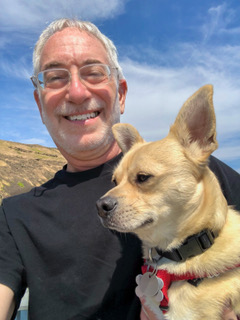
Mark David Gerson is founder of The Mark David Gerson School of Writing and award-winning author of more than twenty books. His nonfiction includes popular titles for writers, inspiring personal growth books and compelling memoirs. As a novelist and screenwriter, he is best known for The Legend of Q’ntana fantasy series, coming soon to movie theaters, and his literary/historical series, The Sara Stories, set largely in Montreal, his hometown. When he’s not writing, Mark David coaches an international roster of both first-time and seasoned writers to help them get their stories onto the page and into the world with ease. (Kyri, in the author photo with Mark David, is named after one of the characters in The Legend of Q’ntana.)
Social Media
Website: www.markdavidgerson.com
The Legend of Q’ntana – www.qntanabooks.com
Facebook: facebook.com/markdavidgerson
Instagram: instagram.com/markdavidgerson.author
Youtube: youtube.com/markdavidgerson
Amazon author page: www.amazon.com/author/markdavidgerson

Leave a comment