Written Author Interview
- Tell me about yourself. What do you like to do outside of writing. What is a day in the life like for you?
My ADHD brain (I’m neurodivergent) means I collect hobbies like others collect postcards. Some of my more recent fixations include restoring old furniture, pyrography, bookbinding, and of course, writing.
For a long time, my days revolved almost entirely around my work as a psychologist—especially between 2020 and 2023, when the mental health demand was at its peak. There really wasn’t much breathing space back then. Things have finally quietened down over the last couple of years, and that’s when I started writing—and haven’t really stopped since.
These days, I still work every day—seeing clients, writing reports, and supervising students—but most of my time outside of work is spent writing. I suppose you could say I’m philosophically opposed to the idea of “having a life.” 😆
2. What inspired your first novel? What was the thing that got you into writing in the first place?
Originally, I was just writing for fun. I’d published a nonfiction psychology book two years earlier—my true debut—and wanted a creative outlet that wasn’t bound by research citations or clinical frameworks.
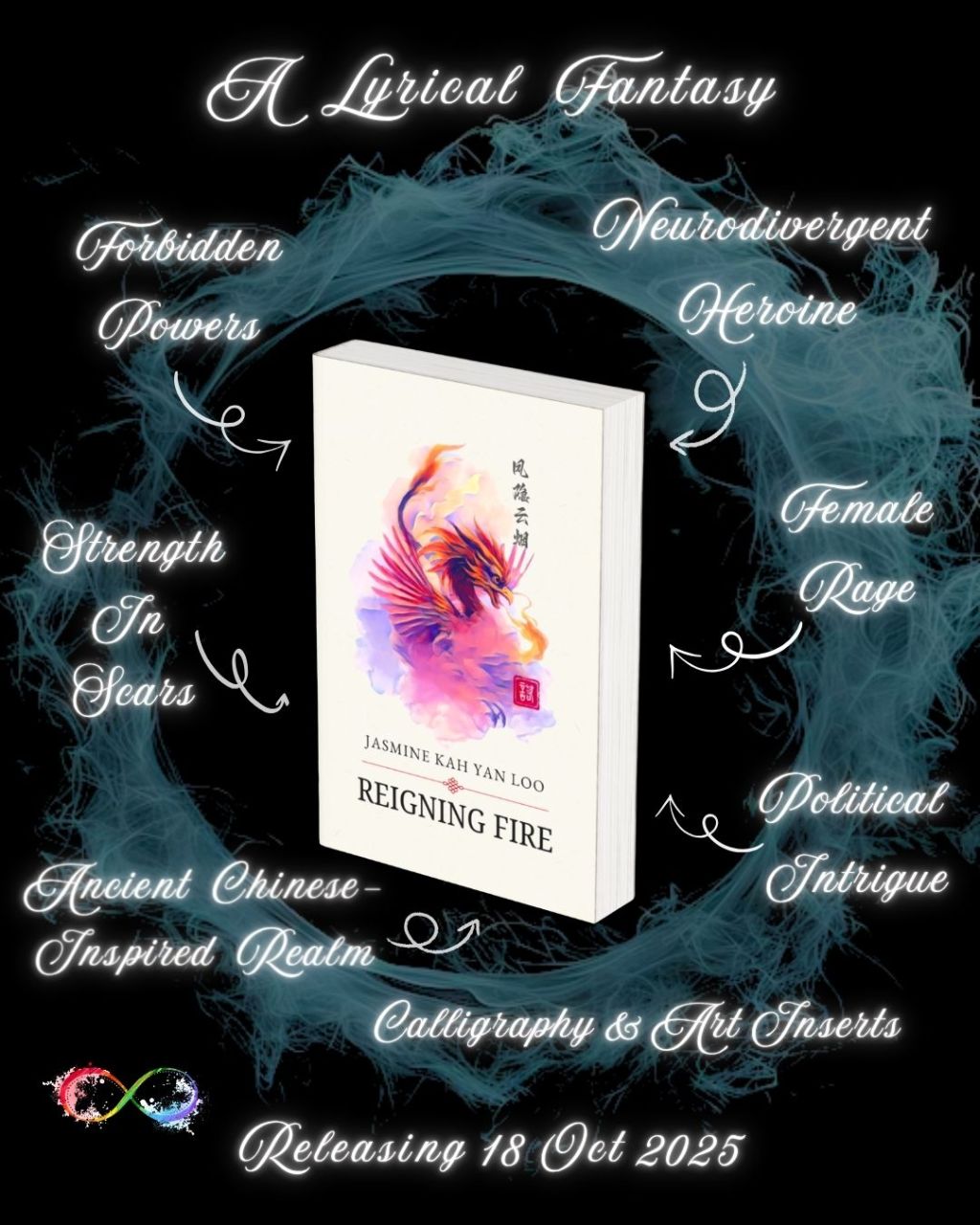
I’ve always been an avid reader of fantasy novels, but being both Asian and neurodivergent, one day I found myself wondering: what would it look like if there were an Asian, neurodivergent heroine in a fantasy world? That thought stuck with me.
I’ve never really seen characters like me—even in the fantasy novels I consider my all-time greats. There are some Asian characters, especially in more recent books, and a few who might be interpreted as neurodivergent, but rarely both. At some point while writing, I realized that even though it was probably a really wild idea to publish something that’s basically a niche within a niche… I had to do it anyway.
3. How do you come up with characters? Are they spontaneous or meticulously planned?
The characters were developed pretty meticulously, guided by the main themes I wanted to bring to life in the story. Many of those themes are ones that kids who grew up in Asia can relate to—things like the relentless pursuit of excellence, or the expectation to endure pain and sacrifice for the sake of family honor.
So, I started with those cultural and emotional threads in mind and built the characters around them. That said, one character in particular—Jin—completely surprised me. I’d envisioned him
a certain way at first, but as the story unfolded, it was as if he took on a life of his own and grew into someone entirely different from what I intended. It was oddly compelling to watch it happen, and I’m really glad I let him evolve instead of forcing him back into my original plan.
4. What are some of your favorite genres to read? Are there any books you’d recommend to first time readers or people looking for something new?
I’ve always loved fantasy and historical fiction—especially stories set in particular historical periods that feel rich with atmosphere. One of my all-time fantasy favorites is Poison Study by Maria V. Snyder. More recently, I came across a most beautiful historical novel by a fellow Australian author, Pip Williams, called The Dictionary of Lost Words. It’s such an evocative, gentle story about language, identity, and women’s voices.
That said, I do occasionally like to switch things up completely. Another one of my all-time favorites is The Mindf*ck Series—but fair warning, you’ll need a strong heart (and gut) for that one. 🤣
5. What’s the most difficult thing about being a writer?
Haha, all of it?
The actual writing part often comes pretty naturally to me, but it’s patching up all the holes in logic that can drive me insane. I’ll be wandering around the house, mumbling to myself while cooking or doing chores, trying to untangle plot issues. Then, when I finally figure something out, I’ll shout “aha!” loud enough to make all my furbabies jump. To anyone watching, I probably do look a little unhinged.
But the hardest part, hands down, is the marketing. Writing what you love is pure dopamine-mining. Holding the proof copy in your hands feels like a miracle — and for a brief moment, you wish that’s all there was to it. That you could just whisper, “Off you go and sell yourself now” and it’ll all come together, like how wild animals come out of the woods and do all your chores in Disney animation.
Of course, it doesn’t quite work that way in reality. So you draw up battle plans, fall flat on your face more often than you’d like, and keep going anyway—hopefully not forever. 😅
6. What is your process to completing a novel from outline to final product?
This feels like a question for a two-day workshop. But I have a feeling you’d want me to be concise. Challenge accepted.
My process is part structure, part chaos—probably fitting, given I’m both a psychologist and neurodivergent. I start with a broad outline that focuses on themes and character arcs rather than rigid plot points. Once I have a sense of emotional direction, I let the story unfold more organically, filling in the gaps as I go.
Back in school—long before I was diagnosed with ADHD—I always got into trouble for never spending any time planning my essays. And it wasn’t for lack of trying! Every time, I’d tell myself, “Do it the right way this time.” But then my ADHD brain would go, “Here’s that sparkle of inspiration! If you don’t chase it now, it’ll be gone!” So, I’d abandon the plan and run with the idea instead. The few times I actually forced myself to plan first, my inspiration fairy did escape into oblivion. Some habits just stick.
So, I don’t do much detailed planning beyond the emotional skeleton of the story. The first draft is usually fast and messy—a “get it out before it evaporates” kind of process. Then I spend a long time refining it, patching logic gaps, tightening dialogue, and reading scenes out loud like a one-person play in my office.
I don’t tend to involve anyone else until the story feels complete in its own right. I tinker endlessly until it feels alive. That’s when I know it’s ready—or at least as ready as it’ll ever be. Then, there’s the part about the vision I’ve got about the reading experience I wanted to curate for my readers For Nurturing Neurodivergence (my nonfiction book), my goal was to make complex psychological ideas accessible through visuals—using infographics and design elements that help readers see the concepts, not just read about them.
With Reigning Fire, I wanted the world itself to feel tactile and immersive. I imagined elements of Chinese calligraphy threaded throughout—from the names of characters and places to the inscriptions on architecture—so that readers could experience the story not just intellectually, but emotionally and visually too.
7. What’s the most unhinged thing you’ve written in your novel? Don’t worry, we don’t judge here.
Probably the scene where one of my characters made a decision so reckless that even I sat back and said, “Are you sure?” I’ve learned not to argue with them—they usually win. But you’ll just have to read it and find out for yourself. 😉
8. What’s one thing about being a writer that absolutely drives you up the wall?
Aside from the constant war with the algorithm gods? Probably having a dozen ideas fighting for attention at once. My brain hardly does “one thing at a time,” so when I sit down to write, it’s like hosting a very loud committee meeting. Half the time I’m writing scenes from three different books because inspiration doesn’t respect boundaries.
9. What does being a successful writer look like for you? What type of life do you want to live as a writer?
Haha, well, first off—not being a starving artist would be nice.
But honestly, the most rewarding thing for me is when a reader shares how my story has touched them—especially when they grasp the deeper layers of meaning woven through it. Reigning Fire is heavily layered in metaphor, and nothing makes my heart sing more than reading a reflection that tells me they truly got it.
It’s a similar feeling when I write nonfiction. The real success comes from knowing my work has helped someone in a meaningful way. One of the most profound things a reader ever told me was, “This wasn’t life-changing for me. It was life-giving.” That line will stay with me for the rest of my life.
So even if I never “make it big” as an author, those moments are enough. But I definitely wouldn’t complain if I did. 😆
10. Describe your writing journey. If you had to write a story centered around it, do you think you could pull it off?
Truth be told, I never planned on becoming a published author. My first book, Nurturing Neurodivergence, actually began as a group psychotherapy program I created for late-identified neurodivergent adults. At the time, one of my students was behind on their hours and asked if I could postpone my annual leave so they could finish placement and graduate on time—and I said yes.
All of a sudden, there was this unexpected gap in my calendar. And of course, I immediately started thinking about how to fill it. The feedback from group participants was so moving that I thought, “Why not make it accessible to more people?” Of course, I quickly discovered there are about 110 extra steps between “I’ll just upload it” and actually publishing a book. I often joke that my obituary will read “death by ‘I-can-do-that.’”
But that experience taught me everything from cover design to typesetting to marketing—and it paved the way for my novel two years later. Once you’ve done it once, everything (except the writing and marketing part!) becomes much easier.
If I ever wrote a story about this journey, I think I could pull it off—though it would probably involve a fair few gremlins, mildly unhinged inspiration fairies, and at least one caffeine-fueled protagonist talking to herself about plot holes. 😆
Follow and Connect with Jasmine Loo
About
Jasmine Loo is a neurodivergent licensed psychologist and author based in Melbourne, Australia. Her acclaimed nonfiction debut, Nurturing Neurodivergence, reflects her passion for neuroaffirming practice and inclusive care.
With her fantasy novel Reigning Fire, she turns to fiction to explore identity and survival in a world woven with myth, history, and imagination. Drawing on her psychology background, Jasmine crafts characters with deeply authentic inner lives, creating fantasy that resonates with emotional truth.
Alongside her writing, Jasmine provides supervision to students and professionals and works with clients at her Melbourne practice, which she founded to create a safe and affirming space where neurodiversity is celebrated.
Social Media
Author Website: https://jasmine-loo.com/
Social Media Links: Instagram | Facebook | LinkedIn

Leave a comment