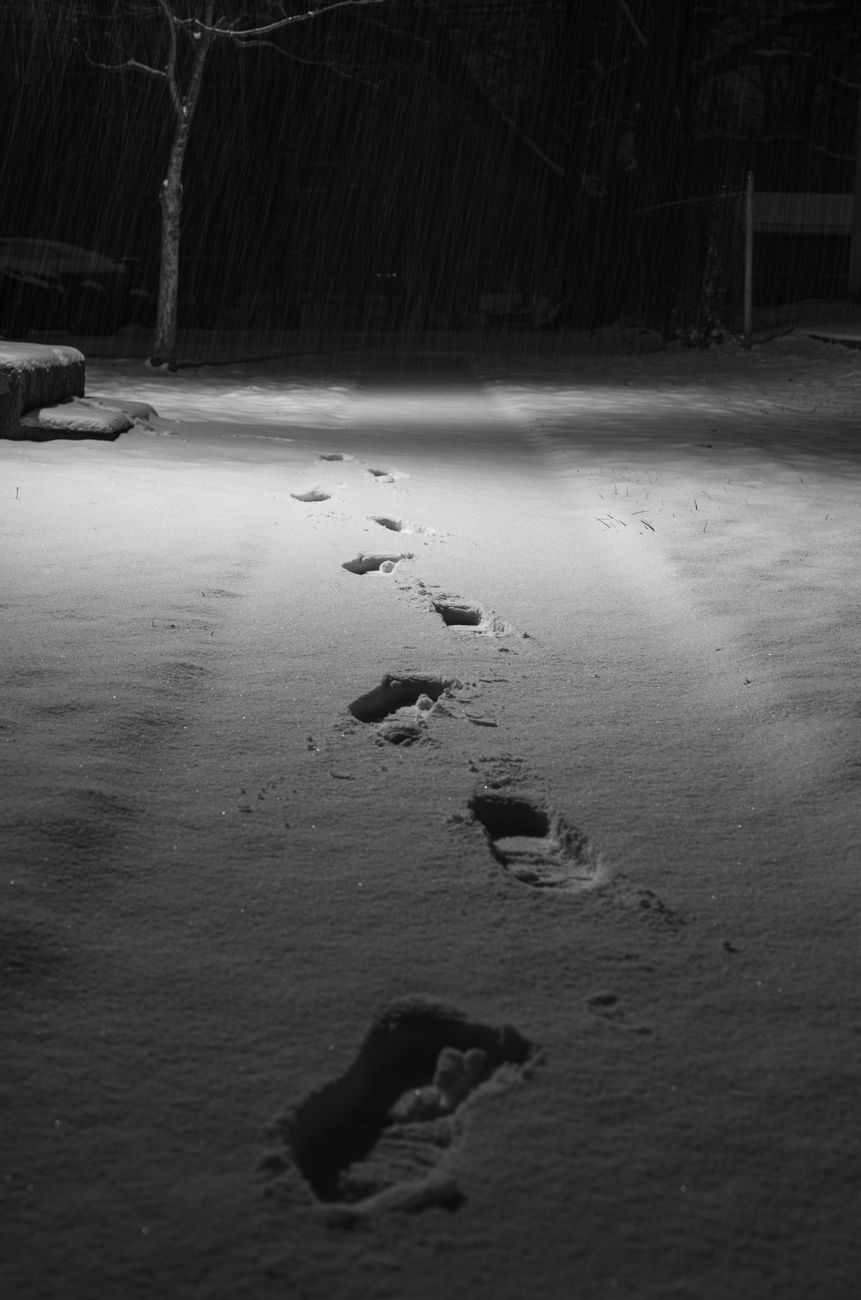
The first thing Yosola hears every morning, before the call to prayer, before the hawkers begin their wandering songs on the street below, before Lagos clears its throat and becomes itself again is the sound of feet. Two feet tapping against the walls waiting for her to stand up from her slumber.
They do not scare her as they have always been there for as long as she could remember. They did no harm to her, however they were distracting sometimes. On some days they would be very loud and on others they would be as stealthy as possible.
She is thirty-one years old and she has stopped telling herself that it is nothing.
What she has never told anyone is this: there are two cities Yosola inhabits. The first is the usual Lagos, always chaotic, the second has no name she has found in any book. It exists in the same space as Lagos but slightly behind it, the way a room looks different in a mirror. Or one could say the back of the mirror which no one can see. The buildings there are quieter. The light falls at an angle that has no corresponding sun. She slips between the two the way most people slip between sleeping and waking, without deciding to, without knowing exactly when the crossing happened.
In both worlds, the footsteps follow.
She was six when she heard the footsteps for the first time. Playing a game of hide-and-seek, in her compound at shomolu, she wedged herself between the water tank and the back fence, her heartbeat so loud she thought it would betray her. She pressed her back into the cool concrete and breathed through her mouth and waited.
And then she heard it: footsteps on the path. It was slow, calculated, echoing closer with each foot on the ground.
She closed her eyes and waited for Tokunbo’s face to appear around the tank and catch her but there was no face. She opened her eyes and saw the path was empty.
However, the footsteps had stopped right where she stood as though whoever wore them had leaned in, close enough to breathe on her cheek.
Then, barely audible, like hearing speech through a thick wall:
Don’t be afraid. I’m not here to hurt you. I’ve been trying to reach you for so long.
Yosola did not hear the words clearly. What she heard was a sound like wind shaped almost into language,which slapped across her face and it terrified her more than silence would have. She ran screaming into the house, looking for her mother.
“You are playing too much, that’s why you are imagining things, have you finished your homework?” She dismissed her as any other parent would.
Seeing as she was not listened to, she learned to deal with it as long as it did not hurt her.
Over the years, she learned the patterns. The steps were loudest when she was afraid. They quickened when she was about to make a decision she would regret. Twice, once at seventeen, once at twenty-four she had stopped at a bus stop while attempting to cross because the steps behind her had become suddenly, violently urgent, and both times, a vehicle had come through the junction running its light. She had no composure, heart hammering, with no way to explain to herself or anyone else why she had stopped.
She had begun, quietly, privately, to trust them but still could not understand why they followed her all her life.
There is a word in the realm, she learned it not from anyone living, but the way you learn things in the in-between, which is to say it arrived in her like a memory of something she had never experienced. The word is Ìparí. It means the appointed end. Not death in the way the Abrahamic religion understands death, something sudden, resisted, grieved. In the realm, Ìparí is the moment a being completes the full circuit of what they were sent to do. The moment the realm calls them home.
Yosola had always known, in the boneless, wordless way you know things you have never been told, that hers was coming early.
She had felt it shifting into view the year she turned twenty-nine. The realm became more present, more vivid as though it were preparing to receive her. Colours in the in between sharpened. The light that had no corresponding sun grew warmer, almost welcoming. She walked through the other realm and it seemed slightly less solid, the buildings a fraction more transparent, as though the city were beginning to let her go.
The footsteps changed too. They became faster and anxious. Beneath them, the almost voice grew louder, still muffled, still just beyond the reach of understanding, but louder like someone pressing their mouth against the wrong side of a door.
You have to listen to me. Please. There is still time. You are not supposed to go yet. Do you hear me? You are not supposed to go yet.
Yosola heard: water. rushing water. and inside it, something that sounded like her own name.
She sat at her kitchen table in Yaba, her tea going cold, and pressed her hands flat against the wood and said aloud, to the empty room:
“I can hear you. I can almost hear you. I don’t know how to hear you.” She whispered, hoping to get a resolve from this.
The footsteps stopped for three full seconds, the longest silence they had ever given her all her life.
Then they resumed, faster than before, more rhythmic like the sound of a beating drum.
……………
Two weeks later
Rushed to the hospital after multiple faint spells, there is a tube in her arm and a window that shows the sky, and Yosola can feel the specific weight of a body
beginning to release its lease on the world. Her hands on the sheet look like her mother’s hands. She finds this unbearable and beautiful at once.
The realm is very close tonight. She can see it at the edges of the room, not threatening, not dark, the way people who have never been there imagine it. It is simply the other place. The one she has been moving between her whole life, where she and other starseeds were tethered to. It is there, if you look hard enough beyond the square walls.
She is not afraid of dying. She is afraid of what she has not yet understood. Then comes the footsteps. She can hear it move briskly down the corridors, past the nurses station, moving with such urgency she has never heard in her thirty one years of being followed.
It conveyed the sound of someone who has been searching a long time and has finally, finally found the right room.
They stop outside her door and for the first time in Yosola’s life, the voice comes through clearly. The way you hear someone standing right beside you in a quiet room. It is her future self, it has always been her future self trying to communicate with her.
Yosola. It’s me. Please, it’s not time yet. I know it feels like time, I know the realm is right there, I can feel it too but this is not your Ìparí. This is a mistake. You have more to do here. You have to fight it. I have been trying to tell you this since you were six years old and I have never been able to get the words through and I am begging you to hear me now.
She turns her head toward the door that no one has opened. Her eyes are dry. Her breathing is shallow and slow, the particular slowness of a tide going out.
“I can hear you,” she blurts with the sparse energy she has left. There was silence on the other end.
“You can hear me?” The voice replied, shock laced in their voice.
“I’ve always been able to almost hear you. Tonight is the first time it’s clear. Who are you? Why tonight?”
I am you, we have many versions of you, but you are important to the lineage because you’re close enough to the boundary. You’re right at the edge between here and there. The closer you get to the realm, the thinner the distance between our times. I’ve been standing at every door you’ve ever stood behind. I’ve been following you since I was old enough to find the crossing point. I watched you almost walk into that junction on Allen Avenue when you were seventeen. I ran until my feet bled in the in-between to reach you in time. And I can’t, I cannot do it now by myself. You have to choose to stay.
Yosola is quiet. This is nothing surprising. Her mother had taken her to the white garment church in Osun state when she was ten for deliverance and the prophet told her she was a strong person who had multiple lives but did not explain further. She enjoyed it during that period as she was given any food she wanted.
She can feel the realm against her like sunlight through a window, warm and, unhurried. She can feel all the accumulated weight of living in two places at once, the exhaustion of thirty one years of translation, of walking with something behind her that no one else could hear.
“How much more time?”
“Enough. Enough time. I promise you.”
The machines beside her bed continue their small mechanical singing. Down the corridor, a nurse laughs at something. Outside, Lagos is doing what Lagos does, generators running their low complaint, a bus shedding passengers somewhere on the bridge, the smell of the Atlantic rain arriving, the specific Lagos rain that
falls as if it has been waiting to fall all its life and has finally been given permission. While all this is happening, she is in transition, the fight for her lives.
Feeling defeated, she closes her eyes but does not go to the realm. She turns slowly, painfully, with the full terrible effort of someone choosing to remain in a world that is heavy and loud and uncertain. She presses her hands flat on the bed and sighs.
The footsteps, slowly, begin to recede. The way someone walks when they are no longer running toward something. The way someone walks when they know the person they love is going to be alright.Her future self rescinds.
“I’ll still be here. Behind you. I’m always right behind you,” they say.
She opens her eyes. The ceiling is white and ordinary. The realm is still there, it will always be there, it is part of her but it has moved back to its proper distance, just past the edge of things, waiting with its usual patience.
She breathes in and breathes out.
Somewhere in another time, she is already becoming the woman who spent thirty one years following herself through two worlds, pressing her voice through the barrier between then and now, wearing grooves into the floors of every room her younger self ever stood in. Somewhere she is already tired and desperate and completely unwilling to stop.
Yosola is not dying, she is transcending. The footsteps aren’t saving her from death, they’re her future self trying to warn her that transcendence means the cycle starts again.
Another her, another endless loop of footsteps trying to warn her for the cross she bears is heavier than the crown of thorn on her head.
There is no end until Ìparí says so.
Follow and Connect with Oluwatoyin Adesida
About
Oluwatoyin Damilola Adesida is a Nigerian fiction writer who is drawn to the darker corners of speculative imagination, she crafts narratives that explore humanity through fantasy, horror, and psychological intrigue. Passionate about telling inclusive stories, she writes diverse characters and queer narratives all grounded in emotional depth and compelling storytelling.
When she isn’t writing, she is an avid Twilight franchise enthusiast and enjoys watching football. Fascinated by morally complex characters and mind bending tales, she writes stories where African roots meet the extraordinary, inviting readers into worlds that are as haunting as they are unforgettable.
Social Media
Instagram: https://www.instagram.com/lolaasuga?igsh=MTJwMzF5M3Znbm1tcw%3D%3D&utm_source=qr


Leave a comment