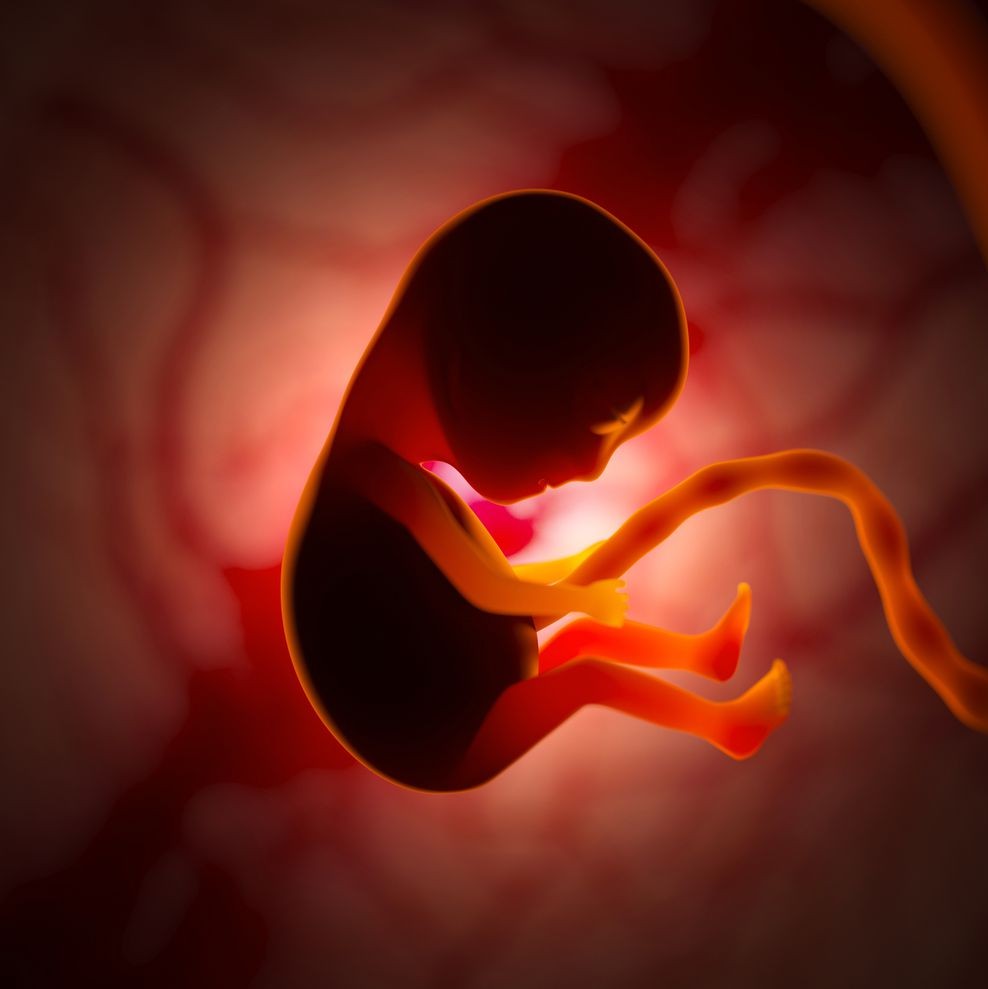
Listen: everything I did was for humanity. But once I started, I couldn’t stop. The idea cluttered my house, transforming every room into a laboratory with vials of blood and thick blankets of paper torn from any coding manual I could get my hands on. I became a hostage to progress. I should have stopped after the first artificial womb’s miscarriage. All those tiny bodies, tied up in medical waste bags, gone to the landfill with milk bottles and takeout boxes. I kept working the conference circuit and publishing my “findings” whenever I needed the cash. It’s true that I wasn’t popular in either of those realms. To inject artificial intelligence directly into the human genome was akin to the psychosexual experiments of the forties, even after years of neural linking and biological alternation therapy.
Progress, I called it. The science world bit into me, like vampires; anything to protect the sanctity of life. My argument: what I was doing was no different to parents who monitored their embryonic genes, except I was allowing machine learning to choose the genetic combinations, resulting in the highest level of success for my offspring. I had no idea, then, how the consequences would burrow much deeper than simple gene-crafting. Still, the other scientists eventually tired of me and moved on to another crisis, a different scandal.
The real money maker was talk shows. I capitalized on the media, made myself into an attractive woman—straight hair, make-up, and just enough cleavage to catch the cameras. I played the smart mother-to-be, someone who wanted a baby desperately and only desired to give their progeny the best possible start. They were eating out of the palm of my hand. “The future of human evolution”, they called it.
After five years holed up and enough calls from expectant donors, I knew I couldn’t catch up even if I wanted to. The only choice left was the hardest one, but it was transparent: I played God with my own body.
In using my own womb, I attached something primal to the experiment. An ache. My body became an instrument and I was willing to do whatever it took to bring that one, tiny idea to fruition. First, I found a sperm donor: a tall man, willing to pass the jizz cup along with no questions asked. And, of course, I screened his genetic profile and found it complementary to mine, which was all I wanted. No desire could pass between him and I—he would have to be faceless and nameless. The fetus wouldn’t need a father.
After the positive pregnancy test, I became something ancient—maternal with my nesting habits and my constant hunger. I watched the body I occupied grow and change, a ship of Theseus rended from flesh. Joy and anticipation replaced desire and pride. The horrible things pregnancy wrought on my body—hyperemesis, preeclampsia—were signs of something greater, a life within my own, an attachment and an arrow pulled back from the bow, ready to snap forward into the future. At the time, the fetus was nothing more than a parasite, draining the blood from me, but I relished in the grotesque and threw myself into more publicity, more opportunities to hold my work to the world and say, “See what I’ve done?”
I was fascinated. People would groan at the gory bits, shudder when I talked about coding the fetus’ genome with AI, and hold their hands over their eyes at my massive stomach. But still, they loved me, loved the progress. And I loved them for loving me.
It wasn’t too long until I was thinking of the fetus as a baby. My life’s work fruited through nine months of pain and one long spell of labor.
Endless, the labor. No doctor in their right mind would support my birth. I contacted midwives and obstetricians, but the American Medical Association put a total order out after all my publicity: no registered member would even contact me.
In my mind, it was better that way. I could bring her into this world on my own, monitor myself with secondhand medical equipment, and finally put my pre-med undergraduate degree to use.
All the bravado in the world didn’t suck away the agony. The baby grew at such an exponential rate as it hurtled towards humanity and I skipped any pain management options—not as some final grasp towards a natural, human element, but to ensure that I stayed lucid and awake long enough to care for myself and for her.
I thought I might die. It was 3:52 in the morning when my daughter came into my arms. Healthy and pink and hardly crying, wide blue eyes looking up at me. I cleared the fluid from her face and wrapped her in a blanket with shaking hands.
I should have known it was over. The end of humanity looked like a baby.
I named her after myself.
The coming weeks made my daughter a mistress of growth milestones, pupating into something beyond a newborn but not quite a child. I could only breastfeed her for a short spell. Her baby teeth came in with force and I had no choice but to refuse her, my nipples sore, aching, and bloody, yet still weeping when she wept.
I wasn’t afraid of her—truly, viscerally afraid—until eight weeks of maternal bliss had passed. I was preparing her dinner, standing on the cold kitchen tile barefoot, humming under my breath. Outside my glass back door, the season was almost spring. It was comforting, in those days, to watch the seasons change through the lens of suburbia.
Softened solids were the only foods that could really keep her full. The steamed carrots and nutritional yeast gave in to the fork with ease and wafted off the revolting smell of pickles and dust. Holding my breath was the only way to get through it. I heard a shuffle from behind me and I nearly dropped the fork.
I closed my eyes and counted to five before saying, “Just a minute, Clara.” She had the lay of the house, then, able to pull herself to her hands and knees and toddle around. Nauseating, how fast she grew. “You’ll eat in just a minute,” I said.
I wiped the fork off on a dirty towel. It fell with a sharp clatter when I turned around, taking her full form in. Her head appeared out of the hallway and through the door, higher than it would have been if she was crawling.
Clara extended one leg out, strangely balanced, giraffe-stepping into the kitchen, towards me, blue eyes blank and endless, pupils dilated, fixed on the mashed carrots, mouth open, tongue beginning to collect drool. Her shoulders were wider than I remembered, set straight as she passed from one foot to the next. Around the edges of her neck, brown hair curled into ringlets.
All parts of her grew fast.
Air left my chest as if vacuum-sealed. All rationality fled, my parasympathetic nervous system blaring alarms at me. Her body inched towards me.
I was a prey animal.
Walking. What was the proper reaction? Would another mother have been proud or have whipped out a smartphone to record her first steps?
But how did I know they were her first?
Carrot shavings scattered to the ground. Without thinking, I had pushed the cutting board off the counter like a barrier, my legs shaking, carrying me to the back door while Clara, ever determined, walked towards me—gait smooth, like an ice skater.
I pushed at the door handle, sliding the door open behind me. Once I felt the cold air on my back, my knees buckled. I scooted out to the patio and slammed the glass back into place. She still watched me, hands open, grasping. Crawling in reverse, I retreated all the way towards the fence line and, upon hitting it, I caught my breath. Through the door, I could see her reach up to grasp the bowl of carrot and yeast, fisting the soggy orange mixture into her mouth, getting it all over her chubby face.
The images played over in my mind. Mirrors of my own, her eyes. All of her looks favored mine, like some sick reminder I played with her genetics before she was even a being. And, fuck, the realization hit. I left the oven on. I left a two-month-old inside the house with the goddamn oven on.
I was not proud of how long it took me to go back inside and shut the oven off. I wish I had just let the whole place burn.
In spite of me—or perhaps, to spite me—Clara refused to quit growing, even as the world around my little townhouse played static. Every day, I felt sore, broken by phone calls where media and popular science superstars (and all the other people who wouldn’t have cared if I lived or died) asked me, their voices over-bright and grating, how I would comment on purported copycats, on the state of the genetic hierarchy groups, or on my current project’s outcome.
But those were nothing compared to the fanatics. I recognized them by their breathing alone; when I answered the call, they would start their ragged inhalations and sharp puffs out, overt in their thrill at talking to me. Of course, there was no way of determining if it was possible for these people to imbibe their own genes with artificial intelligence, but they were religiously convinced of their own evolution. Though I would never give as easily as I had in the past, the voices were inescapable.
I had my theories on why Clara grew with such veracity, why she was intelligent beyond the norm, why she elasticized herself around me in constant changes and adaptations, but I could never quite bring myself to swipe samples of her cell matter to study their decay and replication.
The notion disgusted me. I knew I would break at the truth.
Her immortality was a secret I kept from myself.
To take her away from the world with finality was an impossible notion—though she was wrong, I had begun to think of her as my own flesh and blood, which was a sick fallacy. Instead, I wagered that I could hide her, shutting her away from prying eyes and cutting myself off from society proper.
As soon as I could bear it, I packed up everything I could fit into my hatchback and fastened Clara into her adjustable car seat and we set off for the mountains. Deep in the Smokies stood a rundown house on a large swath of family land, a hunting lodge and my only real inheritance. If I could have enough time and space to get my bearings… I’m not sure what I wanted beyond that.
Clara was agreeable the whole time. I didn’t know if her trust was implicit or because she had no alternative, but I appreciated her thin high voice between the waves of silence. The mountains spread out for miles all around us, violent green and dusty brown, ripe signs of early spring bleeding over the earth. Slow, measured, she called out names for each tree on the way to the lodge—hemlocks and frasiers and box elders. I didn’t want to know how she learned them.
Some things are best left to childish secrecy.
I had exposed her to far too much that I understood. Unmonitored internet access, TV time, all the books I owned—she devoured any bit of information and retained it. It would end as soon as we made it to the lodge, for her protection as well as the world’s.
By that time she was the size of a seven or eight year old—leggy, thin, much like I was as a girl. On our second day at the cabin, I sat her down, my face serious. I could tell she wanted to crawl into my lap, but I kept my hands stiff against her shoulders, looking her in those uncanny blue eyes, stomaching the ache of them. Outside, the wind rushed through the trees, the day unseasonably hot. Soon, there’d be rain and I’d have to put her off of going outside in it and drenching herself.
I couldn’t quite look at her, trying to keep my voice even. “Clara, it’s time for us to discuss rules,” I said.
“Rules?” She blinked at me. Rarely did she blink. It was almost as if she was trying to put me at ease. “Mommy, why do we need rules now?”
My eyes shut. “Don’t call me that,” I said. My facial expression steeled, I continued. “Rules for things that we have to… obey. To keep both of us safe.” Thinking of it then, it was the most we had really talked in her whole short life. I watched her ruffle her full head of curly hair. Uncanny, how much of a mirror she was.
“Okay,” she said.
“Our rules for our house are, number one…” I swallowed. The speech rested in my head, well-prepared but now absent faced with her in the flesh. “You must never bother me when my door is closed.”
“Never bother you when your door is closed,” Clara repeated. Her voice and intonation was exactly like mine.
“And number two…” I closed my eyes again. It was easier to talk to her without looking at her. “You must never go further than the property gates. Ever.” If she took this rule the wrong way, used her mind to parse out the reason why I wanted her isolated, it would all be over. I held my breath.
“Never go beyond the gate.”
“Exactly. Is that simple enough?”
Her head tilted. “What happens if I do that?”
“Bad things!” I snapped. “Horrible things. There’s bears and mountain lions out there and you can get lost.”
Her stare didn’t break. She was egging me on for the gory details.
“Things I can’t even tell you. Don’t go beyond the gate.” I caught my breath as I finished.
My body, stubborn and aching, remained the same as seasons changed around us. Nightly, I rose from bed to pump milk from my breasts as I held my emotions so close to my chest I could hardly breathe. I watched the milk flow down the drain in the kitchen sink, swirling and gurgling, the only evidence I had to prove time was still marching on in normal form.
Most days, I hid. The outside world frightened me. As time wound itself out, I would see more and more about proclaimed copies of my work. I told myself they were simply capitalizing on the fame, the glory; they couldn’t possibly replicate the procedure. Each day, the notion convinced me less.
In perfect contrast to my withering, Clara was impossibly alive. Her body grew longer, thin and narrow like a weed. She finished my sentences beyond what was necessary, and the hunting lodge felt as though it was under constant surveillance, her wide blue eyes tracking every movement, eidetic recordings for later purview.
She became restless. I let her outside on balmy days and her legs took off, fast and agile, like God couldn’t catch her even if he were to wrap his fist around her curly head of hair. She reached the fence’s edge, long off into the woods, and I could almost hear the thwack of her fist against it before she picked up back to me. Quite literally running laps around me. I had dreams, some nights, of her out in the woods. I would try to pace myself ahead of her, duck around bushes and trees, but she would not lose my trail. It was a scent on me, a familiarity, a maternal glow that dragged her ever towards me.
We passed each other in unfamiliar silence. I felt imprisoned. I wasn’t sure how she felt. I wasn’t sure if she had what I could call “feelings”.
I holed up back in my room, leaving only to go to town for groceries and thrift store trips—clothes for Clara’s developing body and, when I was feeling sentimental, books and tapes
for her to consume. She memorized movies on her first watch, able to repeat them in perfect time and intonation whenever she replayed them, which was often, considering the slow growth of our collection. On a whim, I brought home six massive volumes of an encyclopedia the used bookstore marked down and she devoured each one. Another afternoon, I made the mistake of bringing home a guitar. Clara taught herself to play the thing perfectly within hours, replicating classical CDs some elderly relative stashed away in the basement. Later, when she slept, I hid the guitar in the storage shed.
Around the start of her puberty, I found the animal bodies. They had been captured, somehow, from the woods outside and disposed of in the trashcan, split open, vivisected. Clara used the basement for herself. She made a show of moving my computer down there and I didn’t stop her. I should have stopped her. I should have done so much more. But I never made the trip down the staircase, never really forced myself to see the reality of what she was capable of. Cold air drifted up and through the doorway, despite the season. The basement was the part of the house least protected from the elements. It was originally, mostly, a small hovel of a place meant for storing game. Freezers lined the walls, once stuffed with venison. I would never know if she managed to put them to use. Most nights, I dreamt of her, bent over a workbench and wrist-deep inside a body. She was searching for a sign—a method of replication. They were usually dead animals. Sometimes, they were still alive. And in one long dream, the body had been mine.
I heard them before I saw them. Trailing from the hallway—from my bedroom: moaning, grunting, the sharp thwick of skin on skin. The door sat open, gaping, and I set down my grocery bags as my stomach twisted with fear, then disgust. It melted the inside of my torso, turned outwards and morphed into a house fire of anger. All I had done was take care of her, provide for her. I’d ruined my life to bring her into existence. If the noises were—
I slid across the hardwood floor, with steps soft, wavering. Through the hallway and to the bedroom door. For weeks, it had been shut to me as Clara took the house over. At the time, I couldn’t bring myself to care. I could hardly wrench myself off the couch to make sure we had food.
I sucked in a breath and pushed on the door’s handle.
There, on the bed were Clara and a man, copulating. Copulating, the chosen word, because they were primal. Animals, even: hands held onto hands held onto skin slick with sweat, a beast with two backs, her hips swinging, mouths wide open, panting, praying, chanting. I knew the man. He was some neighboring hunter who had once made the mistake of popping by our front door for a visit. That day, Clara had been smaller, biologically a young teen, but she looked at him with such wide, interested eyes—the color of an empty sky. She looked so much like me. And there she was, throwing away the gift I gave her.
“What do you think you’re doing?” I said.
The man jumped, startled. He was probably high, but dull recognition flashed across his eyes. It could have been a familiar rite of passage, catching my “daughter” in the act. “How could you?” I said. My words were directed at Clara, but they landed on her partner. The skin on the back of my neck burned like an iron. “She’s a baby,” I said. “She’s a baby who doesn’t know any better.”
“Oh, God,” he said. Penis out, red all over, ashamed he got caught, or embarrassed. “Oh,
God. I’m so sorry.”
“You—!” I choked. Clara’s blue eyes watched me, unfazed and placid, everything that haunted me. The man let me chase him along the hallway, spitting and screaming. “You pervert!
Get out, get out of here, get out of my house!”
“Your other kid wasn’t home and I thought—”
“She was.” I was crowding him against the front door, close enough I could swipe at his face. “The other kid. That’s who you were… screwing,” I said. His face warped and he whipped away from me. I didn’t deign to watch him as he left, pants half-on, confused and burned and ashamed.
I slammed shut the door. The noise echoed through the house.
I stumbled back to the bedroom, the walls dreamlike, and burst through the door again as if the scene would replay itself. Clara splayed naked across the bed, playing with the edge of a blanket, wholly unashamed of herself. I would never get over how her body looked so much like mine, from the curve in her throat to the slope of her stomach. How could I entertain the belief that I didn’t do this to myself?
In one cold look, she stole my youth from me, sucking the marrow from my bones. My head throbbed. I was so, so tired.
“Are you happy with yourself?” I said.
Clara smiled. It was the same smile she had when she was a baby. The fact she was a baby—technically, chronologically—gripped me. All the ideas I had when I started this warped project. I wanted to create my own life, raise her alone and well, grow close, learn to take care of each other, but all that could ever have been was a story ripped out of a zany sitcom.
I couldn’t breathe.
Tilting her head, she pawed at her exposed skin. My stomach curdled. “The experience was thrilling,” she said. “I wanted him and he was willing. I had him.”
“It’s sick, is what it is. You’re not even two years old.”
“I’m not like you,” she replied. “You’ve made that clear.”
In her eyes—those cold eyes—was everything she couldn’t say, wouldn’t explain to me. Watching Clara’s mind work was like smacking into the wrong side of a two-way mirror. I knew the warp behind the reflection. I knew how wrong it was that the reflection existed in the first place. There was no way I could bear another moment of it.
As I backed towards the door, her face twisted. “You never even let me see a picture of him,” she spat.
“A picture of who?”
“My father.”
Clara had never mentioned the donor before. In my mind, she was always content to exist in the liminal space of accepting the necessity of his existence as well as the fact he wasn’t present, in any sense of the word. He was true to himself; he never showed up wanting to cash in on her. I was thankful he knew to stay out of our lives. Strange, how I felt a thrum of affection for him at that moment. But like other dangerous sparks, I had to snuff it out.
“You don’t have a father,” I said, halfway out the door. “You have a donor and you have me. Congratulations.”
“I do,” she said. “I do have one.”
I left her there, naked.
I left her to my room and her basement and her animals and the computer and the whole run of the house. As long as I had our collection of tapes and a quiet couch to settle down on, I could exist. It was enough to know she couldn’t be anything more than my daughter for the time being.
I woke up and knew. Clara had left.
Outside, the winter breathed overnight through our tiny backyard plot, transforming the space between the cabin and the tree line by white-tipping the green and brown with frost. Thin, careful footprints drifted towards the edge of the grass and disappeared into the fallen leaves. I followed what I understood to be her path through the property, weaving around bushes and frozen puddles until I came upon the gate.
Clara had left her jacket looped over the rusted metal, and I hooked the white fleece around my pointer finger to examine it. There were no signs of struggle or imprints of dirt. It smelled of outdoor air and Dr. Bronner’s peppermint castile soap. I wondered if she’d packed any clothes. But I understood that, as she roared through the woods, she must have decided she didn’t need clothes. Or she didn’t want to take any with her.
I imagined her metabolism burning, a machine deep in her body adapting to any environment, evolving with every breath, firing her through the woods, out to the edge of our mountain, and even further beyond—and then, to where?
Occam’s Razor posited Nashville. It was the closest city to us and housed a major airport surrounded by a sea of people deep enough to disappear into. If she could make it, she’d push forward to anywhere else. I had no delusions about her plans. After my selfish publicity, the world had established an interest in Clara; all she needed was a chance to prove herself as the creation, the result, and she’d find power in this world at her fingertips. Humanity wanted immortality. I had delivered it. What I had to do sped through my mind in the whiplash cold: I would stop at nothing to find her. From the moment her cells collided with mine, I was Clara’s mother. I could not exist as anything else.
Follow and Connect with M. Anne Avera
About
M. Anne Avera is a writer of Southern gothic prose and poetry from Auburn, Alabama. Her work has been featured in Waxing + Waning, Third Wednesday, The Awakenings Review, and others. Her debut collection of poetry, “Complete and Total Honesty” is now available through Neon Origami Press. You can find her at writeranneavera.ghost.io.
Social Media
Instagram/Threads: https://www.instagram.com/prosperity.anguish?igsh=bXBsa2J0MGkycjA5


Leave a comment