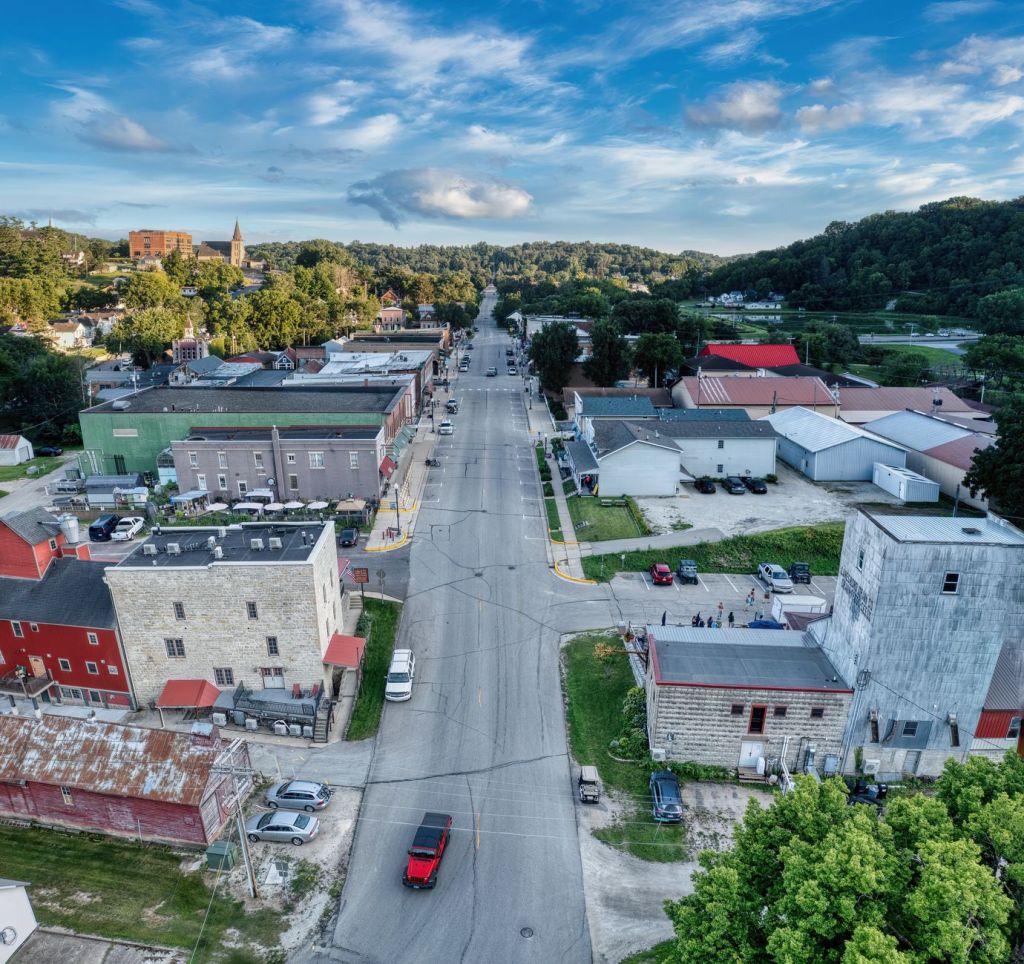
Jackson, Indiana
This story has no moral. Anyone looking for a message has come to the wrong place. Those craving novelty will be disappointed. We speak with the same flatness and plainness as the land from which we came before the people came with their buildings.
We were never meant for much. Then Henry Bridges left his father’s farm to enlist for the Civil War. A strange young man, eyes fired with abolitionist zeal, bent on doing his part in destroying the Slave Power, who left us a private and came back a colonel with medals pinned to his chest, and a contingent of former slaves following him like Moses. We did not know we could produce a hero. Twenty years he labored on his farm, represented the Grand Army of the Republic, and was elected twice to Indiana’s Senate before he found natural gas under his farm.
Then Colonel Bridges changed us. He used his gas to build his factories and his smokestack, proclaiming his name, not mine; with the factories, he brought in Welshmen to make his glass and his other building materials; the blacks that followed him north after the War settled into the Osborne Addition to work in his mansion; and he caused the railroad to come to him. We became Bridges Industries.
The Smokestack
Colonel Bridges laid my first brick; he slathered the first layer of mortar. To that mortar he added a strong dose of his spittle. From there I rose over the city of Jackson, absorbing it into myself until I became the city, serving to lift the effluence from the works below into the heavens above.
The workers make glass and bricks for other buildings far from me, absorbing into myself their energies. I sum up the life of the city and the land from which I sprung from.
I am a spike towering into the heavens.
Above the city, even parts of the county, I towered, broadcasting the name of Bridges to everything with eyes. I stood against the elements; power boiled and pounded in my bowels. The people below looked upon me with awe and respect and pride.
Now more than ever, the people need the reassurance of my power. They no longer think the future holds as much good as the past. The workers talk about the government contracts that got us through the World War Two years have run out, and how people have stopped moving into town. The kids leaving high school wonder why they can no longer go straight to a job that will pay for a house and a car and a family. The politicians and the businessmen fret over the number of people leaving here for General Motors in Anderson or Muncie, or to Chrysler in New Castle. The two men running Bridges Industries, Henry Bridges and David Morgan, back from Harvard, count the glassmakers who have slipped off to Ball Corporation in Muncie. What are foreign wars, failed presidents, or even oil embargoes to me? I am in the business of building, and America is always building. So long as there is work, there is need for what my people make. The people will see their fears are baseless. That I will be here for a long time to come is proven by standing here, pouring forth my daily cloud.
Edith Stevens
I never enjoyed flying; I had never been to the Bridges Industries stockholders meeting, and if my last husband, Gardner, had not died three months ago in the bed of his mistress, I wouldn’t have flown out to Indiana for this meeting. Adding injury to insult, I found he’d mismanaged my money. Always before, I’d trusted my brother Ted to deal with our Bridges Industries stock. He tried to persuade me that I would find the meeting boring, beyond my understanding. Not so much trust now. We flew the corporate jet into Jackson on July 1, 1976. This was my first trip to Indiana. I was fifty-three.
I was coming to the city where my father was born. There was a mansion built by my grandfather, Colonel Henry Bridges. Father mentioned him in his book – the Civil War hero who built the family business. Cousin Hank lived there with his wife. It overlooked the factories to the south. I cannot say I found it impressive other than in its size and its Victorian seriousness. We held the shareholder’s meeting in the library. That room did impress me with three of its walls lined with leather-bound editions of Dickens, Twain, Hawthorne, Kipling, Longfellow, Trollope, Sir Walter Scott, Henry James, Lincoln, Roosevelt, and Booth Tarkington. Here is where I found the only sign of my father: a copy of his book, The Lynching in Paris, sat next to the editions of Parkman’s histories.
I met two sets of my cousins previously unknown to me. George Harvey was the son of my Aunt Anna and Uncle Matthew Harvey; they had come to my first wedding. George brought along his son, John B. and his daughter Katherine. Hank and George were the only ones living in Indiana, but George did not work for the family business. He had inherited the original Bridges farm from his parents, and, even if he did not wear overalls, his red face made him look like a farmer to me. His son had been with the Marines in Vietnam, and he still looked like a Marine. Katherine, I remember most; she was thirteen and looked positively frail compared to her brother, like a princess, and, like me, a late arrival to her family. She was not there for the business meeting but to be company for Doug Reid, son of my other, newly met cousin.
That cousin, David Reid, was from Oregon; the grandchild of my Uncle William Garrison Bridges, who I had never met, that branch having moved to California before I was born. His grandfather had started a branch of the factory in Oakland, California, and his Uncle Thaddeus Bridges kept the branch running until his death in 1956; since then it had been managed by a man appointed by Hank. I wasn’t sure what to make of David Reid, the last of William Garrison’s line. He was a history professor, his wife Alice was an artist, a potter, and I feel quite certain they were Democrats, very liberal Democrats; a very queer duck, indeed. They had brought their only child, Doug, to see where David’s side of the family was from. I remember wondering if the boy would have the same reaction as I had – that this was a good place to be from.
Hank and his wife, Norma, I knew, having met them several times when they had visited the East Coast.
Hank and his assistant, Mr. Morgan, got to the point quickly and brutally enough. Because he was what Ted had called the local prodigy, the first of the Welsh families to have a college education, I listened. The company had fallen behind in making improvements by keeping up our dividends. I had the definite and intent sense that Mr. Morgan blamed us for creating this problem. Not all of us could claim a Harvard MBA, like him. No one had told me that the largest source of my remaining income was at risk. When I mentioned this, Ted answered swiftly enough that I was never interested in anything but how much. Like he was any different.
Hank said the company had two options for survival. The company could sell the overseas operations or go public. According to Mr. Morgan, either would keep the business functioning. What I heard was the end of my dividends.
Cousin George favored selling the overseas operations. He kept repeating that the Bridges family had built the factory, Jackson and its people had come to depend on us, and we had to do whatever would keep the business in Jackson. Which was a very nice sentiment for people whose late husband had lost more money than his life insurance would cover.
Ted asked about making the company public. Again, Mr. Morgan made the explanations. I understood only three things: that we would go on the New York Stock Exchange, have the opportunity to sell out at a profit, and whatever remained would pass from family control. I saw my brother’s ambitions at the same time I saw another way for my dividends to disappear. George disliked the idea for the same reason he liked selling the overseas operations, outside control meant releasing the family’s position in Jackson.
Hank came out for what he called retrenching and concentrating by selling our foreign assets. I noted that they were what was keeping our American operations afloat. I had no idea about that, and even to my mind, unsophisticated in the ways of business, this sounded like a problem. The phrases “retrenchment” and “concentration” were like Greek to my ears until he turned to Mr. Morgan, again. We could not compete any longer with the larger glass-makers for commercial contracts, we had not expanded enough of what he called our capacity; nor had we ever engaged in the consumer trade like that family in Muncie. (Even I understood who they meant; we had never quite accepted the Ball family, as they had come from New York while we were native-born. Having finally seen my family’s homeland, I didn’t think we had a good reason for our bigotry. But bigotry never springs from reason; its danger is thinking it rational.) However, the company had a reputation for specialized glass on which we could expand, and which would exchange market share for higher profits, if it were successful.
I thought it sounded like a fight with an uncertain outcome, other than its cost to my bank account. George’s son liked it immensely, but having been a Marine, I assume it was the prospect of the fight itself that inspired him.
My Reid cousin kept silent. Unlike me, he had no questions. I was the only one making a fool of themselves.
The lunch hour approached without having taken a vote on either option. Hank suggested we should break and think about our choices. A lunch had been prepared by the staff. These were people who had followed Colonel Bridges when he returned from the Civil War, of whom I had heard much – a central legend in our family – and I wanted to see more of them. I am not above a vulgar curiosity. However, even as we were adjourning, I could see what lay ahead was not a pleasant meal but politicking by the men. George Harvey had David Reid pulled aside before we even left the library. Ted was chatting up Mr. Morgan. Hank was bearing down on me with all the subtlety of a Senior approaching a Freshman at a college mixer. I feared having struck him dumb when I said I wanted to see the city.
Seeing I was serious, Hank offered me the use of a car and a driver. I accepted the car, but not the driver. Ted said he was worried that I might get lost; a typical brotherly dig at my intelligence. Ted never had any respect for my intelligence – when I told him of my impending second marriage, he called me a senseless sentimentalist – so I would never think of making my purpose clear to him. Not that I helped myself by not having a glib explanation for wanting to make this expedition. The truth I can admit now. John B. Harvey influenced me; so did my father. I felt seeing the city might help me understand my father. I had not made up my mind, for all I feared for my future. The discussion ended with George appointing his daughter to be my guide and Doug Reid being sent along as part of his father’s educational program and partially because no one knew what else to do with him. No one, least of all myself, knew what would come from this excursion. Without thirteen-year-old Kate, I might not’ve sold out.
Kate Harvey
The therapist has listened to my escapades from junior and high school without any comment, but only a question.
“When did you decide you needed to rebel against your family?”
No one has ever asked me that question – not even myself. The therapist is so soft spoken, so Canadian polite, I don’t want to blow her off. She waits patiently as I try finding an answer.
I say, “I guess the day when the family sold off the factory. It was the last family shareholder’s meeting.”
Not that I really knew then what a shareholder’s meeting was. Or that it was going to be the last one for the family.
The therapist has great control but it is not perfect. A shareholders’ meeting was not expected.
“You wouldn’t have been in the meeting, correct?”
“No, I was only thirteen in 1976. I think that had to be the day I figured out I couldn’t keep hiding how horrible it was to be related to the Bridges. Anyway, that’s all that comes to mind.”
“Well, let’s go into that.”
“Dad dragged me along because these cousins from Portland, Oregon, had brought along their son, and I was to keep him from being bored. Like, I wasn’t bored living there. But Dad said please, and I didn’t want to hurt his feelings.”
“Doug turned out to be more fun than I expected. He didn’t know anything about farming, and he didn’t think the best thing in the world was being a Marine, and he told me how cool it was to live in Portland. He didn’t need me to tell him Jackson was the most boring place in the country. That was the good part of the day.”
“Then came lunchtime, and Dad asked me to show this cousin of his around town. She was from Connecticut, had never been to Jackson, and really wanted to see the town. It got me out of the Bridge’s house. If nobody lived there, we’d call it a haunted house. Doug tagged along. Anyway, I showed her and Doug Bridges Memorial Hospital, Bridges High School, and the Colonel Bridges statue in front of the courthouse. Then she was hungry. There being only one restaurant in all of Jackson, we went to the White Spot. That’s when things went bad for me. People were talking about the business, and they were so angry about what the family had done to Jackson.”
Edith Stevens
After I suggested lunch, Kate directed me to The White Spot, the only restaurant in town. I guess it was what is meant by a greasy spoon. It was loud, crowded, and smelled of fried foods.
It was there I heard someone talking about the stockholder’s meeting. The talk came from a table of middle-aged men sitting at a small distance from us. Not that I was eavesdropping; they were too loud not to be noticed, even though I missed parts of their conversation. What remains branded into my brain went like this:
“No, Mayor, I’m not sure John is right. The family has been taking and taking out of this town since our parents were kids. They act like we belong to them. Every one of them acts like we should kiss their feet. We’ve only got what they’ve given us. They go under, and this place becomes a ghost town. You know that, and I know it, but the Bridges keep taking. Fresh blood, and fresh money might keep us alive. We could make this town into something besides the Bridges’ private amusement park.”
“You want me to quote you on that, Devlin?”
“Real estate is enough of a bitch without that,” said Devlin. “I’m just saying we’re not going to be anything until we get free of them.”
It seemed his fellow citizens did not see eye to eye with John B. Harvey. I might not have Ted’s business knowledge, but I knew they had paid for every dividend I had received from the business. While I gained that pearl of wisdom, Kate started trembling.
Doug Reid
One of the adults, Mrs. Stevens, wanted to see Jackson, and Katie’s dad sent her along as a guide. I went along because I didn’t want to stay with the old people and their business talk.
When Mrs. Stevens said she wanted to eat lunch, Katie got us to a restaurant. There, Kate said some adults were talking about her, but I wasn’t paying attention to anything but Katie. She started crying. I couldn’t get her to stop. Never felt so inadequate before, or since. Mrs. Stevens got us out of the restaurant.
Edith Stevens
“Oh, God,” said Kate. “Mrs. Stevens, they’re looking at me, aren’t they?”
“Why would you think that?” I asked, looking around the restaurant.
I saw our waiter, a boy named Mike, talking to one of the men. Who, I think, was the one called Devlin. The trembling affected her vocal cords, so I thought I should calm her. I suggested they recognize me as one of the shareholders.
“I heard them mention my brother. I hate it here. People know my brother, my father, and they know me. I screw up, and the whole town is telling my dad in five minutes.”
And I knew then she was right. It had been Katherine, not me, Mike had pointed out to the real estate man. However, she did not need to start with the quiet, hard sobs that turned her face a dark red. No longer did she seem like a princess. I caught the boy’s attention, gave him a twenty for the meal, and removed the children as quickly as possible. Doug’s efforts at comforting Katherine were no more successful than mine.
Doug Reid
When we were back at the mansion and away from the adults, Kate thanked me for trying to help. She made me feel a little less like a complete fool. Then she kissed me on the cheek. Which made my day; the first time any girl had ever kissed me, and being fourteen, you take what you can get. It made me feel better than all her words.
She wouldn’t talk about what had upset her. She wanted to hear more of my stories about Portland. I remember her saying she was going to come see me some day. Then her father came and took her away.
Dad tried explaining why we had to leave Jackson the next day. I didn’t see how what had happened at the business meeting affected Katie and me. So what if the adults were angry at one another. I never saw her again.
I wrote her, and she wrote me back. Nothing in her letters made me think she was angry about anything other than living in Indiana and with her brother being her guardian. Then she stopped writing. I thought I had finally bored her.
Edith Stevens
Kate continued giving me a tour of the town by showing me the factories. I thought she needed more time to recover her composure, and I needed time to think over what I heard in the restaurant. By the time I returned to the mansion, I had come to a decision.
Another decision came to me as soon as I pulled into the driveway and saw David Reid smoking a cigarette. I sent Kate and Doug into the house while I told David my thoughts.
His eyes lit up like I felt mine did when I heard the local opinion about our leadership of Jackson.
I voted for taking the business public. Doug and Ted followed suit, probably shocking my brother more than anyone else at the table. Hank and George voted to retrench. We voted again. Hank and Mr. Morgan began looking more and more appalled. George got angry and snarled at Hank not to back down. Hank did not get angry at George, but at Ted.
“You know what happens if there is a deadlock — change your vote. Now.”
David Reid asked what was going on.
“The Colonel set up the Articles of Incorporation, so if there is a deadlock, then we have to sell the company and share the proceeds. Will you change your vote, Mr. Reid?”
He would not.
I told them I would not, either. Yes, I had been thinking about my money, but what I had heard appalled me. I was there because no longer would I just do what the men in my life told me to do. Some of those men had been running the company that ruled the lives of everyone in this town. Besides, changing my opinion when David Reid would not mean I was as changeable, or as weak-minded, as my brother had always made me out to be.
The meeting ended with ill-feeling running down the long library table. Mr. Morgan had orders to find a buyer for all our assets. George and his son left without a word. Ted and I stayed for two more days without Hank saying an unnecessary word to any of us.
Andy Maxwell
I got the call about a fight on a county road. I figured this was going to be the last time I’d be dealing with lovers caught parking. Expecting a husband catching his wife with a boyfriend, I got something different. What I got was a lot worse.
No missing the fact that the man pinning the kid up against the front quarter panel was John Bridges Harvey. Or that the girl screaming at him to stop hitting the boy was his sister Kate. The hitting stopped when I turned on my flashers. Webster County politics were just starting.
I tell John B to step away. He gives me a look like I need to go away. The hand on my sidearm may have been why he walked to the other side of the road. The girl’s screaming doesn’t stop.
“What the hell’s wrong with you, John? You keep following me! You were going to kill him!”
I yell at her to shut up. She keeps screaming the same words. I yell again while I go look at the boy. She keeps screaming, but now her brother is an asshole. Shooting her seems the only way to silence her. Luckily, she runs out of breath.
The boy looks bad. Both eyes are swelling shut. The nose is bleeding. He groans. Kate makes a gasping noise, but wailing follows.
I turn to John B, telling him to stay put. I keep a first aid kit in the car, but I’m not sure if it’s enough, so I also call an ambulance. When I get back to the boy, I put gauze on his nose. I start telling John B his Miranda rights as I try to stop the blood. Harvey glowers at me. He’s my age, a little bigger than me, and he still carries himself like he’s a Marine. I’m pretty sure he could take me. I hope he knows if he makes a move, I’m shooting him.
John B starts talking about how he was just protecting his sister, and that I can’t arrest him. I tell him to shut up and repeat the Miranda recital. Whatever he’s using for brains keeps his mouth shut.
When I ask the boy his name, he’s having trouble speaking. I found his wallet. His name is Mitch Cox. He is seventeen. John B is around thirty. The kid is shorter than me, a real shrimp up against John B.
I ask Kate how old she is. Almost seventeen. She’s dressed. So is the boy. There is nothing to charge Mitch for.
“I want him arrested,” she says, pointing at her brother. “He beat up Mitch because he found us together. We hadn’t even done anything.”
This is a first for me – sister wanting brother arrested. It goes along with what I intend. She makes a choking noise. I guess she’s run out of oxygen. It takes a little of the stress off me.
The ambulance arrives, and so does another deputy. It’s Tom Friend. I tell him what has happened.
“You’re really going to take him in?” asks Tom. “Knowing who he is and his connections?”
“Yeah. Good thing I got my promotion, isn’t it?”
“No shit. Well, get him cuffed and out of here. I’ll get the girl home. Do everything by the book, hear me?”
“I know.”
I cuff John B and put him into my backseat without him giving me any problems. On the way back to Jackson, we did not talk. I see him through booking. Then I go back on patrol, which lasts twenty minutes before I get called back to the jail. Sheriff Drennan wants to see me.
The Sheriff reads me the riot act, but I keep my promotion. John B. Harvey does not even spend an hour in jail. The Cox kid spent a week in the hospital. I had gotten there after the kid’s ribs had been broken, and the internal organs had been damaged. The left eye never worked right again.
More than a year later, when Kate runs off, I am not surprised. Nor am I surprised when her brother comes around demanding we find her. I make sure I only go through the motions.
Albert Hyatt
What I see when I come out of the liquor store is nothing I wanted to see. Kate Harvey has no business with her teenage ass pressed up against my passenger side door. She’s wearing cut-offs and a tube top that leave nothing to anybody’s imagination, and in case anyone might have doubts, she has this shit-eating grin on her face. A blind man would know what was up and run the hell away. I’m dumber than that. I ask her what she wants.
She wants to talk. Like, I haven’t heard that from here to Saigon and a hundred other places in between.
I tell her we’ve got nothing to talk about.
She says, “I didn’t think you’d be scared of my brother.”
If there is one person on this planet I’ve never feared, it is John Harvey. We beat each other up playing football, we tangled in wrestling, and we had more than a few fights in parking lots and other private places during high school. I like to think I’m ahead on wins. Certainly, I’m ahead on points. We’ve not run into each other since I moved back to Jackson, but it’s been only three months.
She’s prettier than her brother could hope to be, but not nearly as smart. If I’ve not run into John, I’ve heard plenty about her. Since her parents died, she’s been giving John ulcers by playing the roundheel.
I say, “Kid, whatever games you want to run on your brother, don’t include me. I don’t like your brother, but that’s between me and him. You’ve got no part in it. But I’ll give you some advice. Use your head, and when you get old enough, get away from him. Now, get away from my car and stay away.”
When she glares at me, I finally find a similarity with her brother. Anger, the desire to whip her opponent, the intense dislike of anyone defying them. But then she does something he would never have done. She crumples and moves away. She was just a kid then. Not a word does she say, even though I expect a stream of cussing.
I get in my car and drive back to my brother’s place. He is still single then, so he doesn’t mind me staying with him. It has taken almost a decade for me to come home to stay. I have finally made peace with myself. That I’m also done with John Harvey disrupting my life.
Mike Devlin
Dad dies halfway through my Senior year. A heart attack at the office. I wasn’t supposed to come back to Jackson. He told me more than once I was going to college so I could get away from Jackson. But the insurance couldn’t keep Mom forever, and Jack Finney couldn’t raise the money to buy the business. I didn’t think he could even keep the business running without Dad. Mom and I argued about it, but I was stubborn, and she couldn’t disagree with me about Jack. Only Theresa had me pausing. We’d been dating for years, just about engaged, but there was no place for her in Jackson. She was meant for bigger things. Not that she wouldn’t follow me back home. Not that she wouldn’t try to make it work. I decided not to put her to the test. It was the dumbest idea I ever had, but it worked. She broke up with me after throwing shoes and a couple of textbooks and finished with a straight right that caught me on the side of my head. She is better off being angry now than being miserable for the rest of her life.
It’s going to take everything I’ve got to keep the business running. I may have already screwed up. Last Saturday, I was getting gas at the Texaco station when Kate Harvey pulled up in her car at the pump opposite me. I can’t miss her standing there in a red tub top and a pair of Daisy Dukes, and she can’t help but see me checking her out.
“You’re Mike Devlin, aren’t you?” she says to me.
I tell her that’s me.
“I’ve heard about you.”
“I hope it was good.”
“That depends. My brother says you’re an asshole, but Judy Barlow’s youngest sister Nana said Judy thought you were a lot of fun.”
“Well, your brother is certainly a piece of shit.”
“You’d not say that if he were here.”
“I’ve told him what I think of him to his face. That’s why he says I’m an asshole.”
“You denying what Judy Barlow said?”
She breathed out and strained the tube top.
“Nope, but you’re too young to find out what she meant.”
“Sure you aren’t scared of John?”
Well, I’ve never been one to turn down a dare.
“Sure.”
“I’m going out to the Pits and get some sun.”
I went in and paid the cashier. Uh huh, the Livingston Pits, a spot that I knew. Another unchanging spot in Jackson County. She followed me in, standing a bit too close. I could smell her perfume. She got in her car. I followed. We had a fine time in the tall grass along the east of the old gravel pits. Dad had always said, “Screw the Bridges.” She was as close as I ever would get to the Bridges. I’ve not seen nor heard from her since, which has given me time enough to savor that hour in the grass and regret every minute. I’ve got to keep my eye on the business.
Kate Harvey
Then the counselor gets to the question I’ve been dreading.
“What caused you to run away from your home?”
“The night before I turned eighteen two boys I knew died, and I got my money free and clear that day.”
“Would you unpack all of that for me?”
I sigh. Telling this story will hurt. I start, my therapist listens more than she makes notes, and I hope my husband is right that I need to do all this.
Turning eighteen meant no more guardianship, no more John controlling my money! I graduated from Webster yesterday, so no more high school! Free of everything, except my asshole brother. I would be getting my money tomorrow and getting my own place. It would only be until I start college, but it was to be my place. I’d get back at John for all the shit he had pulled since Mom and Dad died. I meant to drive him crazy knowing that I’m partying my ass off, having all the boys I want, and he can’t do anything about it. He thought I embarrassed him and the stupid Bridges family name, but he was going to learn he’d not seen anything yet! That night with Joey Collins at the Livingston Pits for a graduation party was going to be the start of my celebrations.
John was doing his thing at the American Legion. Those were his kind of people. They let him think he was still in the Marines.
Joey showed up on time in that great Firebird of his. Before he put it into drive, he handed me a big, fat joint. The stereo blared AC/DC. Everything was going to be cool. We’d smoke this joint on the way there, drink some beer there, and then find a comfortable spot for me and Joey to have some personal fun. He was promising to rock my world. I let him think my world wasn’t always being rocked.
Only Pete Moran was there, too. Before dating Joey, I was going out with Pete. Neither of us knew Pete was going to be there – there were other parties. We didn’t even run into him until we’d been there for a while. It’s not like there were streetlights out there – its darkness was why we were all there. Not that we were supposed to be there, either. It was kind of private property. There were some little campfires going, and the moon was out. That was the light there was. When I did see him there, I didn’t think he’d make a big deal of me and Joey. Everybody knew I didn’t keep a boyfriend for long. John called that my lack of morals. But Pete must’ve seen us because he came up and got loud and pounded Joey hard on the back. I pulled on Joey’s arm to get him away from what I thought was going to be a fight. I’d seen enough of John’s violence towards my boyfriends, and Pete got really mad then. Joey laughed loudly. I pulled on his arm, and this time he came with me. Getting away from Pete was all I wanted to do, but I didn’t really know where I was going. I heard Pete coming after us fast, and I waited to feel him pulling on Joey; only he ran in front of us and stopped. He had his fists up, telling Joey he couldn’t hide behind me, calling me a slut. Then his arms started to flail. In the moonlight, I thought he was trying to fly. Joey shook me off and ran for Pete. I saw Joey grab one of Pete’s arms. That was when they disappeared. I might’ve started screaming even before I heard their bodies hit the rocks in the quarry.
Flashlights came out. People looked into the quarry. Not me. The voices yelling that they were down there and not moving was enough. I started hyperventilating by then. Everyone was heading for their cars. I couldn’t move. Then somebody grabbed my right arm and then my left arm and started dragging me to a car. I started fighting them until I saw the one on my left is Debbie Wilson. I knew her. She was a year behind me at Webster High School. Pretty sure that was all I knew then, and it’s damned strange even now that I knew even that. She got me in the car. That’s when I got introduced to John Hardy. They got me out of there. Then home. There I got very, very sick.
The next day, the paper was all about what happened at the Pits. John asked me if I knew anything about it, and I lied as much as I had ever lied to him. He might’ve wondered why I hadn’t touched my breakfast if he hadn’t had to check on a cow ready to drop a calf. He left, I got my bag, then got in my car. I made a beeline for the bank.
It was in the bank parking lot that I glanced up at the smokestack and froze. You could see that stupid smokestack even out at the farm. But that was the first time I remember ever really looking at it. The bright letters spelled out Bridges Industries. Its brick shaft overpowering all of us on the ground. I was supposed to get the money for the apartment and head over to Devlin Realty to sign the lease. Only the thought came to me that living in town would put me right under that smokestack. The fights with John would never stop. Now people would be wondering if Joey would still be alive if he hadn’t been with me. It was stuck here, not me. I decided I had to get away. I knew I would only cause more harm if I stayed.
Inside, I asked for all my money. The banker tried arguing me out of that by persuasion at first and then by threatening a call to John. They didn’t think I knew what I was doing. That I was being just a stupid girl. The men in their banker suits changed their tune when I said I would call Henry Lieber and see what my lawyer had to say. They found my cash and a bag for it quick enough then. Dad always said the only thing that scared bankers was lawyers. I was laughing when I left the bank. I laughed at the smokestack when I got into my car. Then I pointed the car north because that was the shortest route out of town.
I only stopped laughing when the car’s radio played the Simon & Garfunkel song that goes, “Nothing but the dead and dying/Back in my little town.” I cried most of the way to Fort Wayne.
The therapist asks if I ever think of going back home. I shake my head.
“I’m free of that life, why go back? I’m free of being a Bridges.”
She hands me a box of tissues. Time remains for this visit, but the session ends.
The Smokestack
The ground moves. Change comes with the Bridges surrendering their power. The new owner arrives with promises of new hires, upgraded equipment, and a new day for the factory. Jobs, a steady paycheck, will make the people happy. However, the new owner does not put their name on me.
Edith Stevens
Never again did I set foot into Indiana. I had enough money from the sale of the company to survive the years of Jimmy Carter.
When George and his wife died, I sent flowers. Ted had given me a clear indication that our presence was not welcome. For that reason I did not put in an appearance at Norma’s funeral or a year later at Hank’s. George B. Harvey did not even send flowers to Ted’s funeral.
Oddly, George B. Harvey telephoned me in 1982, wondering if I had been in communication with his sister Kate. I had not, and I asked why he should think so. That was when I learned she had run away. That did not surprise me. When I told him I would let him know if she did contact me, I lied to him. I thought I owed the girl that much. She deserved her freedom, too.
A week before I died, I saw in the Wall Street Journal that the company that had bought us out was shutting down all operations in Jackson. So much for good intentions.
The Smokestack
For the first time since my last brick was laid, there is no heat, no smoke, and no life surging up from below into me. No voices carry to me from the yard. The wind brings me the babble from the city: cries of despair about what comes next, arguments over rent money, denunciations of Mr. Morgan and of the new owner, and confused conversations about what kind of workers they are without the factory. I feel the last the most. What is a smokestack without smoke from the workers?
I must defy the decay reaching up from the ground into my bricks and mortar. Pigeons roost and begrime me, as if I am just another monument,
People no longer look upon me with undiluted awe and respect. I remind them of what has gone wrong with their lives. Those who have not left the city for jobs elsewhere, remain enduring their losses, persisting in the face of an uncertain future.
They live within my shadow. A witness to the worth of their lives as much as what went wrong. They can take pride in what they did and were capable of doing. Looking upon me, they can hope for the return of the purpose and prosperity that will justify their persistence. We are all bowed and battered, refusing to see in the factory’s demise proof of our worthlessness.
I retain my value. I rise above the flat landscape, still carrying the Bridges name for all to see.
Follow and Connect with Samuel C. Hasler
About
Samuel C. Hasler is a former lawyer , 66 years old, residing in Muncie, Indiana. Hasler has three published: “Passerby” through Thin Air Magazine, and “Exemplary Employee” in the anthology Dreams of Rust and Glass, and “Going for the Kid” through Freedom Fiction Journal; and the short play “Getting What You Asked For” in Lost Lake Folk Opera v9.
Social Media

Leave a comment